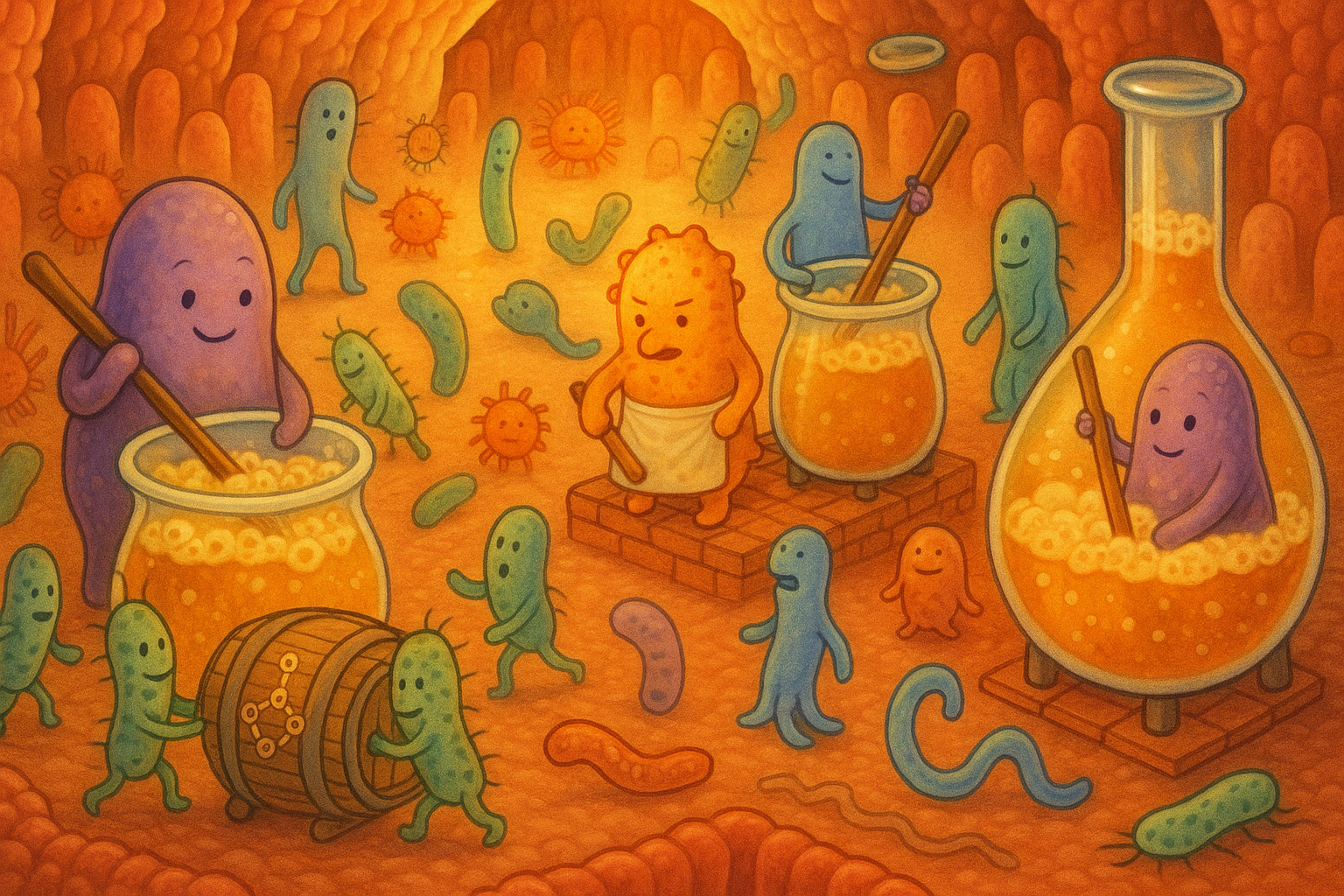
Your Gut Microbes Are Master Brewers Inside Your Body
~ The fermentable fiber feast that’s transforming our understanding of health from the inside out
What if the most important brewery in the world wasn’t in Belgium or Germany, but inside your own body? While we’ve spent decades obsessing over counting calories and macronutrients, an invisible ecosystem within our digestive tract has been quietly transforming humble plant fibers into potent health-promoting compounds. The revelation that your gut bacteria function as microscopic brewers—fermenting dietary fibers into short-chain fatty acids (SCFAs)—isn’t just changing nutrition science; it’s upending our fundamental understanding of how food connects to everything from inflammation to mood regulation.
The Hidden Fermentation Factory You Never Knew You Had
We humans love to take credit for our fermentation achievements—from sourdough to kimchi to craft beer. Yet the most sophisticated fermentation operation might be the one running 24/7 inside our colon. Unlike the carefully controlled environments of commercial breweries, your internal fermentation system relies on trillions of microorganisms breaking down complex carbohydrates that your own digestive enzymes cannot.
These fermentable fibers—resistant starches, inulin, and other prebiotic compounds—travel through your digestive system like tourists with no exit visa, refused absorption in the small intestine and continuing their journey to the colon. There, they encounter your gut microbiota, a community more diverse than the population of most major cities.
What happens next is nothing short of biochemical alchemy. Your microbial residents transform these indigestible fibers into SCFAs, primarily acetate, propionate, and butyrate. These compounds aren’t just metabolic byproducts—they’re powerful signaling molecules that influence virtually every system in your body.
“The capacity of fermentable fibers to stimulate SCFA production varies substantially,” notes research published in the journal Gut Microbes. “Resistant starch from potatoes increases total SCFAs and butyrate more effectively than resistant starch from maize or inulin.”
Not All Fiber Is Created Equal
The common wisdom that “fiber is good for you” turns out to be an oversimplification worthy of retirement. Fiber isn’t a monolith—it’s a diverse family of compounds with dramatically different effects on your internal ecosystem.
Think of fermentable fibers as different programming languages, and your gut bacteria as specialized coders. Some bacteria can only work with specific “code,” while others are more versatile. This explains why dietary studies often produce contradictory results—participants’ responses depend largely on which bacterial “programmers” reside in their gut.
Research examining various fiber sources found that potato starch led to the greatest increase in SCFAs, particularly butyrate, while maize resistant starch and inulin produced significantly less impressive results. The difference lies not just in the fiber structure but in the presence of specific bacterial species like Ruminococcus bromii—the master codebreaker of resistant starches.
This bacterial species serves as a primary degrader, breaking complex starches into simpler compounds that butyrate-producing bacteria like Eubacterium rectale can then utilize. Without R. bromii, even the highest quality resistant starch might pass through your system largely unfermented—like having premium coffee beans but no grinder.
In one particularly revealing study, scientists observed that oat bran fiber, despite being highly fermentable, showed surprisingly low SCFA production and absorption. Meanwhile, sugar beet pulp fiber generated substantial amounts of SCFAs that were readily absorbed. This stark contrast underscores how fiber source significantly impacts SCFA dynamics.
The Microbial Orchestra in Your Gut
Your gut microbiome isn’t just a collection of random bacteria—it’s more like an orchestra where each section plays a distinct role in the symphony of metabolism. Some bacteria specialize in breaking down specific fiber types, while others focus on converting intermediate products into final SCFAs.
This orchestration becomes apparent when examining how resistant starch is processed. Ruminococcus bromii, the primary degrader, increases in abundance when resistant starch is consumed. This rise correlates with increases in Eubacterium rectale, a butyrate producer that thrives on the breakdown products created by R. bromii.
“This synergy explains variations in butyrate levels among individuals consuming the same fibers,” researchers note in the Journal of Functional Foods. Your unique microbial composition essentially determines how effectively you can “harvest” health benefits from the fibers you eat.
The relationship works both ways—the fibers you consume shape which bacteria thrive in your gut, and your existing bacterial community determines how well you process those fibers. It’s a feedback loop that evolves throughout your lifetime, influenced by factors ranging from antibiotic use to stress levels.
Beyond Digestion
The health benefits of SCFAs extend far beyond keeping your colon happy. These compounds are like molecular messengers that travel throughout your body, influencing systems you’d never expect to be connected to your diet.
Butyrate, for instance, serves as the preferred energy source for your colon cells, maintaining the integrity of your gut lining. But it doesn’t stop there—it also regulates gene expression through epigenetic mechanisms, potentially influencing everything from cancer risk to aging processes.
The metabolic effects are equally impressive. SCFAs help regulate blood sugar levels and improve insulin sensitivity, making them valuable allies in diabetes prevention and management. They’ve also been shown to reduce inflammation and lower cholesterol production, contributing to heart health.
Research published in the Journal of Nutrition confirms that “SCFAs like acetate, propionate, and butyrate can decrease total cholesterol levels,” offering a powerful mechanism through which fiber intake influences cardiovascular risk.
Perhaps most surprising is the emerging evidence linking SCFAs to brain function and mental health. The gut-brain axis—once considered fringe science—is now recognized as a crucial communication channel, with SCFAs playing key signaling roles. These compounds influence neurotransmitter production, microglial function, and even the integrity of the blood-brain barrier.
Your Personal Microbiome Fingerprint
If everyone ate identical diets rich in fermentable fibers, would we all produce the same SCFAs in the same amounts? The research emphatically suggests otherwise. Your microbial composition is as unique as your fingerprint, shaped by factors including:
- Birth method (vaginal vs. cesarean)
- Early childhood exposures
- Antibiotic history
- Geographical location
- Diet history
- Stress levels
- Sleep patterns
- Exercise habits
This individuality helps explain why nutrition studies often produce frustratingly variable results. What works wonderfully for one person might do little for another—not because the intervention is flawed, but because their microbial communities process the same foods differently.
The personalized nutrition movement has seized on this understanding, with some companies now offering microbiome testing to guide dietary recommendations. While this field remains in its infancy, the principle that our responses to food are mediated by our microbiomes is firmly established.
The Competitive Ecosystem
Your gut isn’t just a passive fermentation vessel—it’s a fiercely competitive ecosystem where bacteria vie for resources and territory. Fermentable fibers play a crucial role in this microbial politics by favoring beneficial bacteria over potential pathogens.
When beneficial bacteria ferment fibers, they produce SCFAs that lower the pH of the gut environment. This acidic environment inhibits the growth of many pathogenic bacteria, creating a natural defense system.
Research examining how fermentable fibers affect pathogen growth found that “fermentable fibers support acidogenic bacteria growth and yield substantial SCFA production, which together prevent C. difficile growth and toxin production.” This mechanism helps explain why fiber-rich diets are associated with lower rates of intestinal infections.
The production of SCFAs also stimulates the production of antimicrobial peptides and strengthens the mucus layer that lines your intestines, further reinforcing your gut’s defensive capabilities. In this way, fermentable fibers act as both food for beneficial bacteria and indirect protection against harmful invaders.
From Farm to Pharmacy
The potent health effects of fermentable fibers and their resulting SCFAs have sparked interest in leveraging these compounds for therapeutic applications. Researchers are exploring SCFA supplements, designer prebiotics, and even fecal microbiota transplants to manipulate the gut ecosystem for health benefits.
However, these approaches face significant challenges. SCFAs taken orally are largely absorbed in the small intestine, never reaching the colon where they’re most beneficial. Designer prebiotics show promise but must be carefully tailored to individual microbiomes. And fecal transplants, while effective for certain conditions, carry risks and remain poorly understood.
For now, the most reliable approach remains dietary—consuming diverse fermentable fibers to nourish your existing beneficial bacteria. This isn’t as simple as eating more bran flakes. It requires a varied diet rich in different fiber types:
- Resistant starch (cooled potatoes, green bananas)
- Inulin and fructooligosaccharides (onions, garlic, Jerusalem artichokes)
- Pectin (apples, citrus fruits)
- Beta-glucans (oats, barley)
- Arabinoxylans (whole grains)
Each of these fiber types feeds different bacterial populations, creating a more diverse and resilient gut ecosystem.
When Fiber Fermentation Goes Wrong
While the benefits of fermentable fibers are substantial, they’re not without potential downsides. For some individuals, particularly those with irritable bowel syndrome, certain fermentable fibers can trigger uncomfortable symptoms including bloating, gas, and abdominal pain.
These reactions don’t necessarily indicate a problem with the fibers themselves but may reflect underlying dysbiosis (microbial imbalance) or heightened gut sensitivity. The FODMAP approach—which temporarily restricts certain fermentable carbohydrates before gradually reintroducing them—has proven effective for many IBS sufferers.
Even for healthy individuals, rapidly increasing fiber intake can cause temporary digestive discomfort as the gut microbiome adjusts. The key is gradual introduction, allowing your bacterial community time to expand populations that can effectively process these fibers.
Rethinking Nutrition Through the Fermentation Lens
The emerging understanding of fermentable fibers and SCFAs demands a fundamental shift in how we think about nutrition. The traditional model focusing solely on nutrients directly absorbed by human cells misses the critical role of our microbial partners.
Perhaps we should view ourselves not as single organisms but as superorganisms—human cells in partnership with microbial collaborators. In this model, feeding our microbiome becomes as important as feeding ourselves.
This perspective might help explain why traditional diets across cultures, despite their differences, share a common thread of containing diverse plant fibers. These traditional dietary patterns evolved over generations, likely selected partly for their effects on gut health and SCFA production.
Brewing a Healthier Future
The fermentable fiber revolution isn’t just changing nutrition science—it’s opening new avenues for addressing some of our most pressing health challenges. From metabolic disorders to inflammatory conditions to mental health, SCFAs and the bacteria that produce them offer potential intervention points.
As one researcher poetically put it, “We’re not just what we eat; we’re what our bacteria eat too.” By nourishing our internal brewers with the right fermentable materials, we potentially influence health outcomes far beyond the gut.
The next time you enjoy a meal rich in plant foods, remember that you’re not just feeding yourself—you’re providing raw materials for trillions of microbial workers who repay you with powerful health-promoting compounds. In the intimate brewery of your colon, ancient biochemical processes unfold that modern science is only beginning to understand.
This isn’t just a story about fiber or bacteria—it’s about rediscovering our place in the biological world and embracing the microbial collaborators that have been with us since the beginning of human history. Perhaps the future of health isn’t in novel pharmaceuticals or cutting-edge technologies, but in the humble, ancient process of fermentation happening inside us all.
References
-
Gibson, G. R., et al. (2017). Expert consensus document: The International Scientific Association for Probiotics and Prebiotics (ISAPP) consensus statement on the definition and scope of prebiotics. Nature Reviews Gastroenterology & Hepatology, 14(8), 491-502.
-
Venkataraman, A., et al. (2016). Variable responses of human microbiomes to dietary supplementation with resistant starch. Microbiome, 4(1), 33.
-
Jonathan, M. C., et al. (2012). In vitro fermentation of 12 dietary fibres by faecal inoculum from pigs and humans. Food Chemistry, 133(3), 889-897.
-
Martínez, I., et al. (2010). Resistant starches types 2 and 4 have differential effects on the composition of the fecal microbiota in human subjects. PloS one, 5(11), e15046.
-
Koh, A., et al. (2016). From dietary fiber to host physiology: short-chain fatty acids as key bacterial metabolites. Cell, 165(6), 1332-1345.
-
Den Besten, G., et al. (2013). The role of short-chain fatty acids in the interplay between diet, gut microbiota, and host energy metabolism. Journal of lipid research, 54(9), 2325-2340.
-
Louis, P., & Flint, H. J. (2017). Formation of propionate and butyrate by the human colonic microbiota. Environmental microbiology, 19(1), 29-41.
If you’ve enjoyed this article it would be a huge help if you would share it with a friend or two. Alternatively you can support works like this by buying me a Coffee