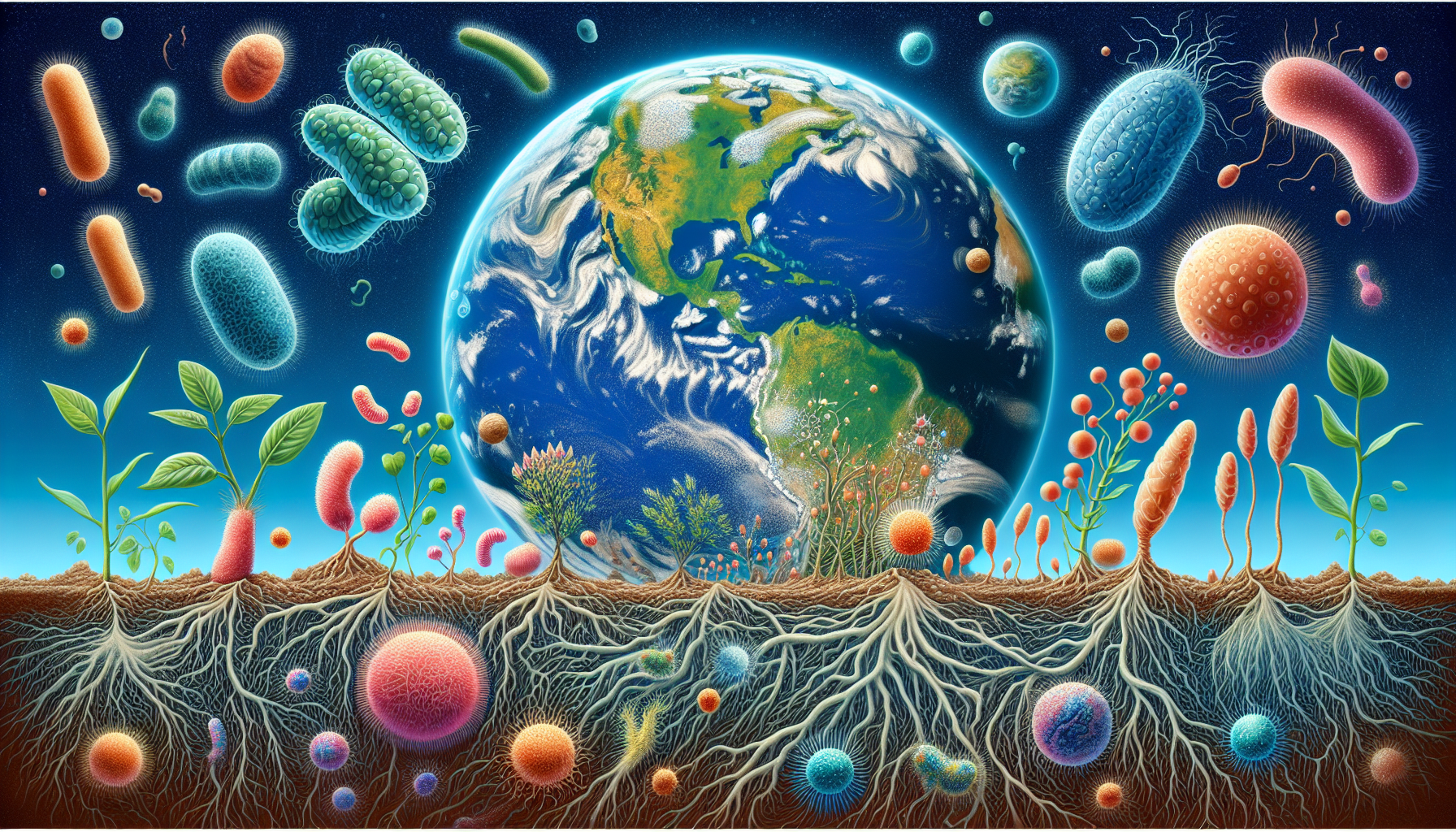
Tiny Editors, Big Impact: How CRISPR Could Transform Soil Microbes and Our Planet’s Future
~ When the smallest interventions might yield the most significant environmental returns
In the quiet microscopic world beneath our feet, a revolution is brewing – one that could upend how we think about agriculture, climate change, and our relationship with the natural world. This article explores how CRISPR gene editing technology, already transforming medicine and crop science, is poised to alter the very foundation of our food systems by modifying the invisible architects of soil health: microbes. You’ll discover: how this precision tool might enhance carbon sequestration to fight climate change, boost crop yields through improved soil fertility, and potentially create more resilient ecosystems – all through targeted modifications smaller than the eye can see. But as we’ll examine, this power comes with profound ethical questions that challenge our assumptions about environmental stewardship.
As we journey through the science behind this microscopic frontier, you’ll gain insights into the surprising ways bacteriophages – viruses that infect bacteria – could serve as molecular delivery trucks for genetic modifications in complex soil communities. Later, you’ll explore the ecological chess game that unfolds when humans alter microbial genomes, with potential moves and countermoves that could reverberate through entire ecosystems in ways we might not anticipate.
The story of soil microbe editing isn’t just about technical capabilities but about questioning our right to rewrite nature’s code beneath our feet. By the end, you’ll understand both the promise and peril of this technology, equipped to participate in one of the most consequential environmental debates of our time. Let’s dig in – literally and figuratively – to discover: what might happen when humanity’s newest editing tool meets Earth’s oldest living communities.
The Invisible Ecosystem Engineers
Soil might seem like mere dirt to the casual observer – brown stuff good for growing plants. This underappreciation mirrors how we once viewed our own gut microbiome: as passive passengers rather than active contributors to our health. In reality, soil functions more like a living superorganism, powered by billions of microscopic entities engaged in complex biochemical conversations that have evolved over millennia.
These tiny life forms – bacteria, fungi, archaea, and more – perform environmental services that would cost farmers trillions to replicate artificially. They convert atmospheric nitrogen into forms plants can use, break down organic matter, sequester carbon, outcompete pathogens, and even produce compounds that trigger plant immune responses. They’re the original chemists, working ceaselessly in the dark.
“Efforts are underway to enhance carbon removal capabilities of soil microbes using CRISPR to address climate change challenges,” note researchers in the field, pointing to perhaps the most tantalizing possibility: engineering microbes to draw down more atmospheric carbon and lock it away in soil.
What makes CRISPR technology so revolutionary in this context isn’t just its precision, but its targeted approach. Unlike broad interventions like applying chemical fertilizers – akin to carpet bombing the soil ecosystem – CRISPR offers a sniper’s precision. It allows scientists to modify specific microbial species within the complex soil community without necessarily disrupting thousands of beneficial neighbors.
The technology operates through an ingenious delivery system that seems straight from science fiction: bacteriophages. These virus-like entities are nature’s own microbial hunters, evolved specifically to find and infiltrate particular bacterial species. By loading these natural “seek-and-destroy” mechanisms with CRISPR gene-editing tools instead of their usual destructive payload, scientists have created microscopic precision delivery vehicles.
“The use of engineered bacteriophages to deliver CRISPR-Cas editing machinery in soil microbial communities enables targeted gene editing of specific bacteria within the microbiome, promoting beneficial interactions with plants and supporting sustainable food production,” explains one research team that successfully modified a specific bacterium within a synthetic soil community.
This capability represents a profound shift in our relationship with soil ecosystems. Historically, humans have influenced soil microbial communities through blunt instruments: tilling, applying chemicals, changing crops. Now, we stand at the threshold of directing the evolution of specific soil microbes with nucleotide-level precision – a power both breathtaking and sobering.
Beyond Green Thumbs: Agriculture’s Microscopic Frontier
Conventional agricultural wisdom has long focused on what happens above ground – the visible realm of stems, leaves, and fruits. CRISPR technology initially followed this pattern, with researchers developing disease-resistant grapes and crops that rebuff parasitic invaders by editing plant genomes directly. But the most revolutionary agricultural applications may ultimately lie in what we can’t see.
Think of it as the difference between renovating a house (improving the plant) versus upgrading the foundation and surrounding infrastructure (enhancing the soil microbial community). Both approaches have merit, but the latter potentially offers greater systemic resilience.
“CRISPR/Cas9 has been used to edit plant genomes conferring disease resistance and improved growth, with potential future implications for managing plant-microbe interactions in agriculture,” researchers note, pointing to the complementary approaches now emerging.
This belowground focus represents a philosophical shift as much as a technological one. It acknowledges that plants don’t exist in isolation but as participants in complex ecological relationships. The plants we harvest are, in many ways, just the visible manifestation of these unseen partnerships.
Consider nitrogen fixation – the process by which certain bacteria convert atmospheric nitrogen into forms usable by plants. This biochemical magic trick saves farmers billions in fertilizer costs where it occurs naturally. What if CRISPR could enhance these microbes’ efficiency or extend this capability to work with additional crop species? The result could be crops that effectively fertilize themselves through their microbial partners.
Or consider the rhizosphere – the narrow zone of soil directly influenced by root secretions and microorganisms. This biological hotspot determines much of a plant’s nutrient access and disease resistance. CRISPR-modified microbes could potentially transform this zone into a more hospitable environment for crops, creating what amounts to a customized protective bubble around root systems.
“CRISPR research has expanded into agricultural microbiology to uncover: and manipulate roles of microbes in soil and plants,” confirm scientists tracking this emerging field. This expansion reflects growing recognition that the most elegant solutions often work with, rather than against, natural systems.
The implications extend beyond conventional agriculture. Imagine restoring degraded lands with specially tailored microbial communities that jumpstart ecosystem recover:y, or developing microbiomes that help crops adapt to changing climate conditions. Such applications would represent a hybrid approach – neither purely “natural” nor conventionally engineered, but something that occupies a middle ground that challenges our categorical thinking about environmental management.
Playing Ecological Chess: The Ethics of Editing Earth’s Oldest Communities
When we modify soil microbes, we’re not simply changing isolated organisms; we’re potentially altering ecological relationships that have co-evolved over billions of years. This reality demands careful consideration of the cascading consequences that might follow even well-intentioned interventions.
The soil microbiome isn’t merely complex – it’s dynamically complex, constantly evolving through horizontal gene transfer (the microbial equivalent of sharing recipe cards) and adaptation to environmental conditions. This creates what scientists call “emergent properties” – system behaviors that cannot be predicted by studying individual components alone.
“Studies have highlighted risks of off-target effects and gene transfer among microbial populations leading to ecological imbalance, emphasizing the need for rigorous assessment before environmental deployment,” warn researchers cognizant of these complexities.
The potential for unintended consequences becomes particularly concerning when considering horizontal gene transfer – bacteria’s remarkable ability to exchange genetic material directly, even between different species. Unlike plants or animals, where genes typically flow vertically from parent to offspring, bacterial genes can move laterally across the microbial community like gossip at a cocktail party.
This raises a provocative question: Could a beneficial modification designed for one species become problematic if it transfers to another? Once released into open soil systems, genetically modified microbes and their novel traits might spread in ways virtually impossible to predict or control.
Adding another layer of complexity, soil microbiomes vary dramatically across landscapes – what works beneficially in one region’s soil might disrupt another’s. This heterogeneity makes universal solutions unlikely and increases the importance of localized testing and adaptation.
Beyond these technical concerns lie deeper philosophical questions. Does humanity have the right to intentionally direct the evolution of microbial communities that predate us by billions of years? Are we wise enough to rewrite the genetic code of organisms that have survived every mass extinction event in Earth’s history?
“Ethical and regulatory issues remain critical challenges for agricultural applications of CRISPR, with public caution particularly strong in Europe,” researchers observe, highlighting the diverse cultural attitudes toward genetic modification.
This ethical terrain becomes even murkier when considering global power dynamics. Who will control this technology? Who benefits from its deployment? Will small-scale farmers have access to beneficial microbial modifications, or will this become another technology that primarily benefits industrial agriculture?
The question of regulatory frameworks adds further complications. Different nations approach genetic modification with varying levels of caution, creating a patchwork of standards. Some regions apply the precautionary principle, requiring proof of safety before deployment, while others focus on documented harm before restricting use.
These ethical considerations aren’t reasons to abandon research into microbial editing, but they do suggest that technological capability alone shouldn’t drive deployment. The capacity to modify doesn’t automatically confer the wisdom to do so appropriately.
Threading the Needle: Toward Responsible Innovation
How might we navigate this complex territory, balancing innovation with appropriate caution? The path forward likely involves multiple complementary approaches that acknowledge both promise and peril.
First, contained experimentation offers a middle ground between unconstrained release and abandoning the technology altogether. Laboratory studies using synthetic soil communities can reveal much about potential interactions before any environmental deployment. Greenhouse trials in semi-contained settings represent another step that balances innovation with precaution.
Second, ecological monitoring tools must evolve alongside editing capabilities. Current methods for tracking microbial community changes in the field remain limited – like trying to monitor changes in a vast city by interviewing a few random residents. Developing better surveillance techniques would enable both pre-release assessment and post-release monitoring to detect unintended consequences early.
Third, the scientific community might adopt staged deployment approaches, beginning with applications that offer significant benefits with minimal risk profiles. For example, modifications to microbes already used in contained bioremediation projects might present lower risk than widespread agricultural applications.
Fourth, inclusive governance frameworks that incorporate diverse perspectives – from molecular biologists to ecologists, farmers to ethicists – could help ensure that development proceeds with appropriate checks and balances. This multidisciplinary approach acknowledges that the questions raised by microbial editing transcend purely technical considerations.
Finally, transparency and public engagement represent crucial elements of responsible development. The history of genetically modified organisms demonstrates how public rejection can derail even scientifically sound innovations when stakeholders feel excluded from decision-making processes.
What makes this balancing act particularly challenging is the global nature of both soil ecosystems and climate challenges. A modified microbe released in one region might eventually spread globally, affecting ecosystems far beyond national boundaries. Conversely, the climate benefits of enhanced carbon sequestration would be shared worldwide, creating complex risk-benefit calculations that transcend borders.
The Microbial Frontier
The soil beneath our feet contains more genetic diversity than all the world’s rainforests combined. This invisible ecosystem, which humanity has often taken for granted, may hold solutions to some of our most pressing environmental challenges – if we approach it with both innovation and humility.
CRISPR technology offers unprecedented capability to modify the microscopic architects of soil health with precision previously unimaginable. From enhancing carbon sequestration to boosting crop resilience, the potential applications could transform agriculture while addressing climate challenges. Yet this same power raises profound questions about ecological consequences and humanity’s proper role in directing evolution.
This tension between technological capability and ethical responsibility isn’t unique to microbial editing, but it takes on particular significance given soil’s fundamental importance to all terrestrial life. We literally cannot live without healthy soil ecosystems – they produce our food, filter our water, and regulate our climate.
As we continue developing these capabilities, perhaps the most important question isn’t what we can do with this technology, but what we should do. The answers will emerge not just from laboratories but from broader societal conversations about values, risk, and our relationship with the natural world.
The soil microbiome represents one of Earth’s oldest and most successful evolutionary experiments – a complex, adaptive system that has sustained life through ice ages, asteroid impacts, and countless other planetary upheavals. As we consider using our newest editing tools to modify these ancient communities, perhaps our approach should balance scientific ambition with appropriate reverence for systems that have sustained life for so much longer than human civilization has existed.
In this microbial frontier, wisdom may prove as important as technical capability in determining whether CRISPR becomes a tool for ecological healing or unintended harm. The choice, like the soil microbiome itself, is complex, consequential, and ultimately ours to make.
If you’ve enjoyed this article it would be a huge help if you would share it with a friend or two. Alternatively you can support works like this by buying me a Coffee