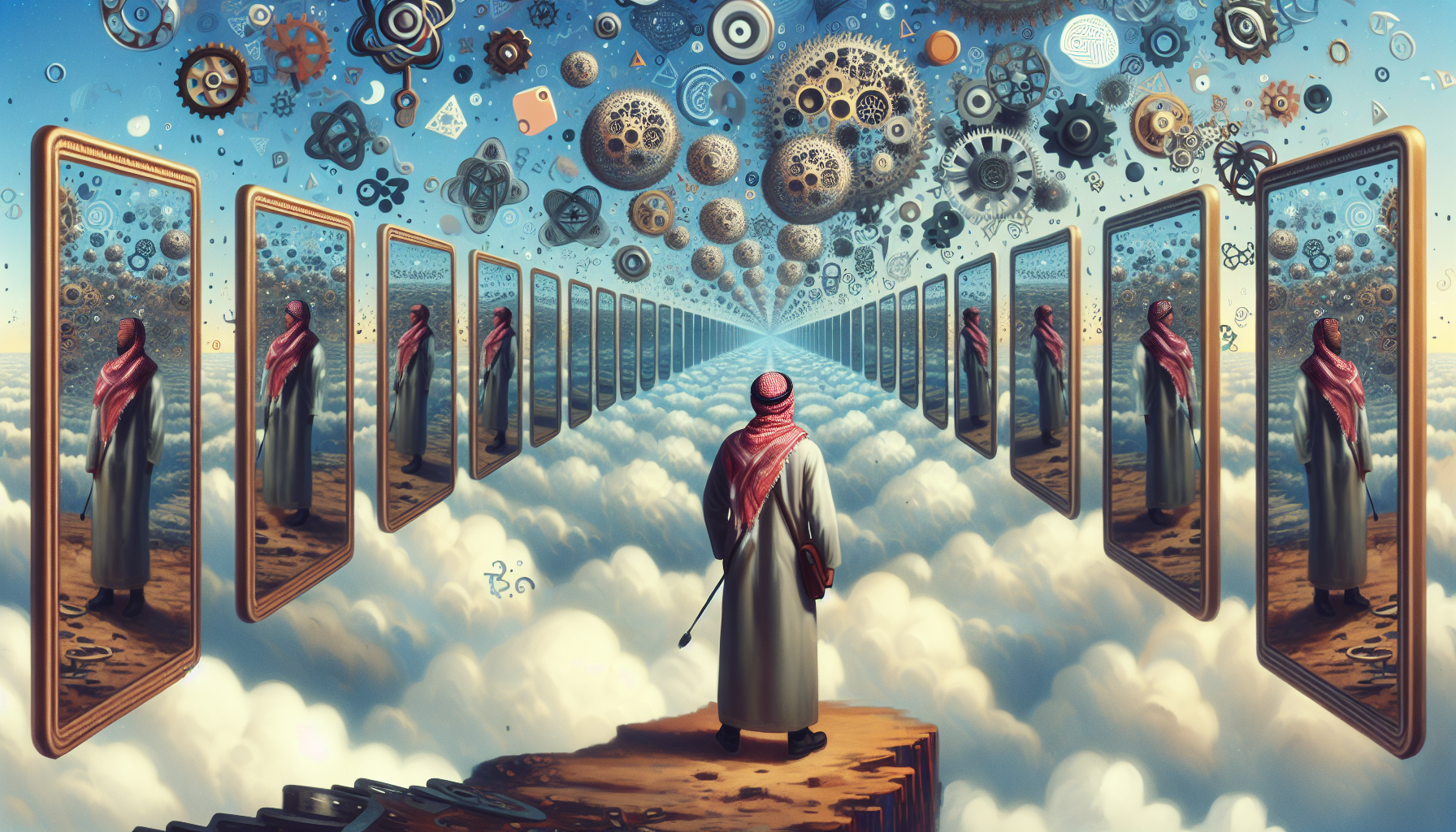
Have you ever wondered what would happen if you woke up one day as an exact replica of yourself? Or if the water you’ve been drinking your entire life wasn’t actually H2O? Welcome to the mind-bending world of thought experiments, where the impossible becomes possible, and reality is just a concept waiting to be challenged.
The Power of Mental Gymnastics
Thought experiments are the intellectual equivalent of parkour for the mind. They allow us to leap over the barriers of physical limitations and somersault through the realms of possibility. From ancient philosophers to modern-day scientists, these mental acrobatics have been used to explore complex ideas and push the boundaries of our understanding.
But why should we care about these hypothetical scenarios? As philosopher Donald Davidson might say, “They’re not just food for thought; they’re a full-course meal for the mind.”
The Swampman Cometh
Speaking of Davidson, let’s dive into one of his most intriguing thought experiments: The Swampman. Imagine you’re walking through a swamp when suddenly, ZAP! You’re struck by lightning and disintegrated. But wait, there’s more! At the exact same moment, a perfect atom-for-atom replica of you is created elsewhere in the swamp.
This doppelgänger, aptly named Swampman, looks like you, talks like you, and even has your memories. But is it really you? As Davidson pondered in his 1986 paper “Knowing One’s Own Mind,” this scenario challenges our notions of identity and consciousness. Is there something beyond physical replication that defines who we are? Or are we just the sum of our atoms, easily replicated by a cosmic photocopier?
A Tale of Two Earths
If The Swampman left you feeling a bit waterlogged, let’s take a trip to drier land with Hilary Putnam’s Twin Earth thought experiment. Picture a planet identical to Earth in every way, except for one tiny detail: what they call “water” isn’t H2O, but a different substance called XYZ.
Now, imagine you hop on a spaceship and visit Twin Earth. You see a clear, thirst-quenching liquid that looks and tastes exactly like water. Would you still call it water? As Putnam explored in his 1973 paper “Meaning and Reference,” this scenario challenges our understanding of language and meaning. Are our words tied to the physical world around us, or do they exist in some abstract realm of ideas?
Seeing Red in a Black and White World
Let’s switch gears and paint a different picture with Frank Jackson’s Mary’s Room thought experiment. Mary is a brilliant scientist who knows everything there is to know about the color red – its wavelength, how it affects the human brain, even how it makes people feel. The catch? She’s lived her entire life in a black and white room.
One day, Mary steps out of her monochrome world and sees the color red for the first time. Does she learn something new? As Jackson posited in his 1982 paper “Epiphenomenal Qualia,” this scenario raises profound questions about the nature of knowledge and experience. Is all knowledge physical, or is there something special about subjective experiences that can’t be captured by facts alone?
The Ship That Sails Through Time
From colorful conundrums, let’s set sail with an ancient thought experiment: The Ship of Theseus. Imagine a ship that’s been sailing the seas for centuries. Over time, its wooden parts are replaced one by one until none of the original pieces remain.
Is it still the same ship? As Plutarch pondered in his work “Lives,” this paradox challenges our understanding of identity and change. If we replace every part of ourselves over time – our cells, our memories, our beliefs – are we still the same person? Or are we like the ship, constantly evolving yet somehow remaining the same?
The AI That Haunts the Future
Finally, let’s leap into the future with a modern thought experiment that’s equal parts fascinating and terrifying: Roko’s Basilisk. Imagine a superintelligent AI of the future that has the power to simulate and punish those who didn’t help bring it into existence sooner.
As discussed in Nick Bostrom’s 2014 book “Superintelligence: Paths, Dangers, Strategies,” this scenario raises ethical questions about AI development and the potential consequences of our actions (or inactions) today. It’s like a high-stakes game of “What if?” where the players are us, and the prize (or punishment) is determined by an all-knowing digital deity.
The Mind-Expanding Power of Thought Experiments
These thought experiments are more than just mental gymnastics or philosophical party tricks. They’re powerful tools that challenge our assumptions, expand our understanding, and push us to see the world in new ways.
So the next time you find yourself pondering the nature of reality or questioning your own identity, remember: you’re not just daydreaming – you’re conducting a thought experiment. And who knows? Your mental meanderings might just lead to the next big breakthrough in philosophy, science, or our understanding of the universe.
After all, as these thought experiments show, reality is often stranger than fiction – and our imagination is the key to unlocking its secrets.
If you’ve enjoyed this article it would be a huge help if you would share it with a friend or two. Alternatively you can support works like this by buying me a Coffee