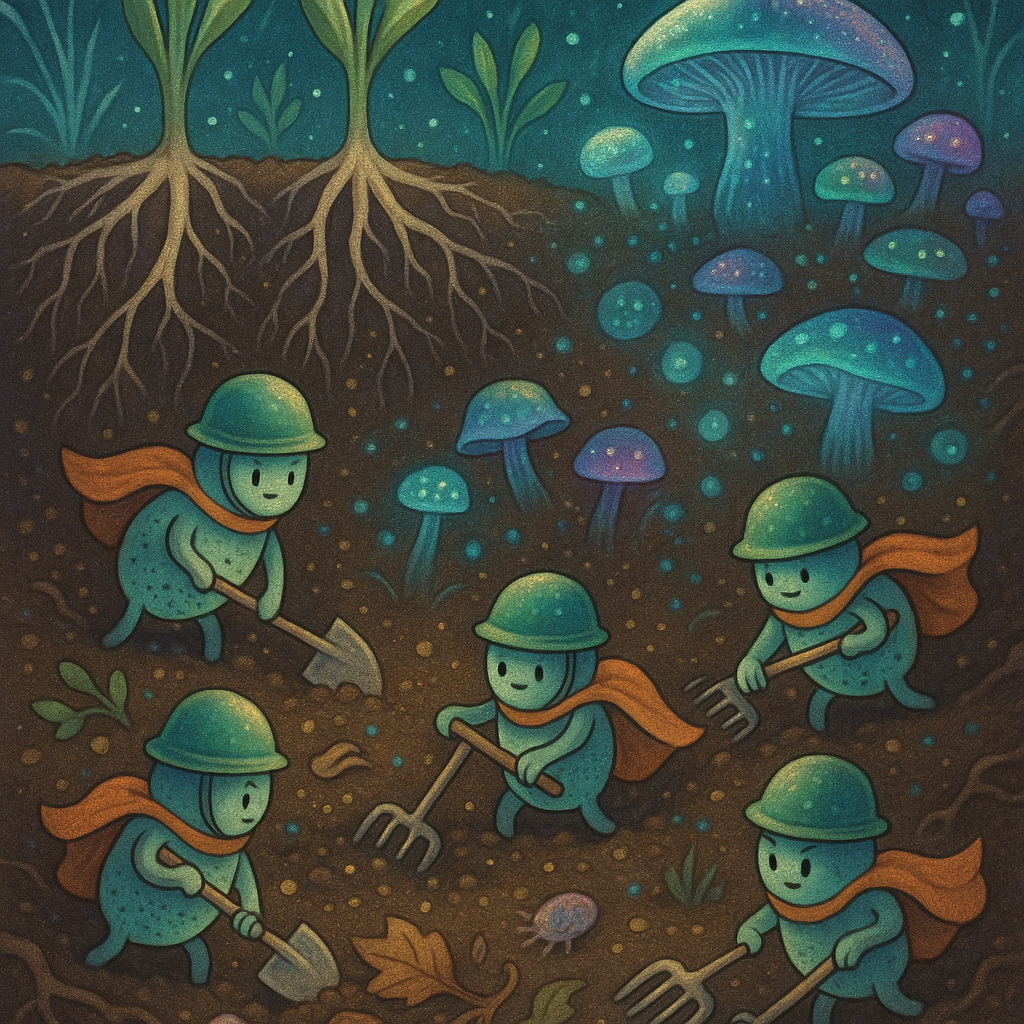
The Invisible Army Beneath Our Feet: How Soil Microbes Might Save The World ~
What if the answer to our most pressing agricultural and environmental challenges isn’t found in a laboratory or high-tech solution, but lies just beneath our feet? In the teeming microscopic wilderness of soil – home to more organisms than there are stars in the known universe – scientists are uncovering an extraordinary genetic library that could revolutionize everything from food production to climate change mitigation. The soil, as it turns out, might be our planet’s most underappreciated supercomputer, running complex algorithms of life that we’re only beginning to decode.
When Dirt Becomes Data: The Metagenomic Revolution
The term “soil metagenomics” might sound like obscure scientific jargon, but in reality, it represents one of the most significant breakthroughs in our understanding of the natural world. Much like how astronomers once gazed at distant stars with the naked eye before telescopes revealed galaxies beyond imagination, soil scientists were once limited to studying only what they could culture in a laboratory – representing less than 1% of soil microorganisms.
Metagenomics has changed everything. Rather than trying to isolate and grow individual microbes – a bit like attempting to understand a symphony by listening to musicians practice alone – soil metagenomics sequences all genetic material extracted directly from soil samples. This approach captures the entire microbial community in one go, revealing both who’s present and what they’re capable of doing.
“Soil metagenomics involves extracting and sequencing total DNA from soil samples to study the genetic makeup of all microorganisms present,” explains Dr. Janet Jansson, a leading soil microbiologist at Pacific Northwest National Laboratory. The techniques involved range from shotgun metagenomics, which provides a comprehensive look at both microbial identities and their potential functions, to targeted approaches focusing on specific microbial groups or genes.
This technology isn’t just an incremental improvement – it’s akin to suddenly being able to read the thoughts of billions of microscopic beings simultaneously. Where traditional methods might identify a few dozen species in a soil sample, metagenomic sequencing can reveal thousands, along with millions of genes encoding their metabolic capabilities.
But why should anyone outside of microbiology care about this invisible world? Because these microbes form the foundation of life as we know it.
The Soil’s Social Network: Ecological Insights Through Digital Lenses
If social media has taught us anything, it’s that relationships and connections define communities. The soil ecosystem works in remarkably similar ways, with microbes forming complex networks of cooperation, competition, and communication.
Through metagenomic analysis, researchers have identified what amount to “microbial influencers” – key bacterial taxa that serve as bioindicators of soil health. A large-scale study across North American farmland pinpointed 348 bacterial genera strongly correlated with organic matter content and other soil health metrics. These microbes don’t just passively exist in soil; they actively shape its character and functionality.
What’s particularly humbling is how much remains unknown. In many metagenomic studies, up to half of the DNA sequences discovered don’t match anything in current databases. We’re essentially finding biological code written in languages we haven’t yet learned to translate.
This invisible ecosystem performs services that would cost trillions to replicate artificially: cycling nutrients, filtering water, sequestering carbon, and suppressing disease. The soil microbiome works like a biological operating system running countless applications simultaneously – decomposing organic matter, converting atmospheric nitrogen into plant-available forms, breaking down pollutants, and building soil structure.
But here’s the counterintuitive truth: despite soil’s fundamental importance to human civilization, we’ve traditionally treated it like dirt. Modern agricultural practices often inadvertently target soil microbes like friendly fire in a war zone – with conventional farming sometimes resembling a scorched-earth campaign against the very allies we need most.
From Laboratory to Field: Farming with Microbes, Not Against Them
Here’s where things get truly fascinating. Metagenomic studies comparing different agricultural systems have consistently shown that organic and regenerative management practices foster significantly different microbial communities than conventional approaches.
“Fields managed using regenerative practices harbor higher microbial diversity and functional capacities beneficial to plant health,” notes Dr. David Montgomery, professor of geomorphology at the University of Washington. “These include enhanced nutrient cycling and natural disease suppression mechanisms.”
Consider this paradox: modern agriculture has largely focused on feeding plants directly through synthetic fertilizers while suppressing pests and diseases through chemical controls. Yet plants evolved for millions of years to partner with soil microbes, essentially outsourcing many critical functions to their microbial allies. We’ve been trying to bypass a sophisticated biological system with a simplistic chemical approach – like replacing an orchestra with a single synthesizer.
This understanding is transforming agricultural practices. Companies like Trace Genomics now offer affordable metagenomic sequencing services coupled with extensive soil databases, allowing farmers to benchmark their soil’s microbial communities against healthy reference soils. This information helps them make management decisions that nurture beneficial microbes rather than inadvertently harm them.
The implications are profound. Rather than seeing soil as merely a growth medium to pour fertilizers into, farmers are beginning to view it as a living system to be nurtured. The potential benefits include reduced input costs, improved drought resilience, enhanced nutrient density in crops, and significant carbon sequestration – addressing multiple global challenges simultaneously.
Breaking the DNA Bottleneck: Technical Innovations Making Metagenomics Practical
Until recently, metagenomic analysis remained largely confined to research institutions with sophisticated equipment and computational infrastructure. Extracting and sequencing DNA from soil – one of the most complex substrates on Earth – presented formidable technical challenges.
Soil contains countless inhibitory compounds that can derail DNA analysis, rather like trying to hear a whispered conversation at a rock concert. Early methods often required laborious purification steps that were expensive, time-consuming, and inconsistent.
Recent innovations have transformed this landscape. Patented sample preparation methods now enable faster, more reliable DNA extraction from soil. Sequencing technologies have simultaneously become more powerful and less expensive – dropping in cost even faster than Moore’s Law predicted for computer processors.
“These innovations allow differentiation between closely related pathogens and integration of microbial data with soil chemistry,” explains Dr. Poornima Parameswaran, co-founder of Trace Genomics. “This helps farmers and scientists track the impact of agricultural management on soil ecosystems over time.”
The democratization of these technologies is creating a virtuous cycle. As more soil samples are analyzed, reference databases grow more comprehensive, improving the interpretation of future results. What once required a PhD to understand can increasingly be translated into practical recommendations for land managers.
The Global Soil Genome Project: Mapping Earth’s Microbial Heritage
The most ambitious initiatives in this field aim to create comprehensive reference maps of soil microbial communities across the planet. These efforts parallel the Human Genome Project in scope and potential impact, but focus on cataloging Earth’s microbial diversity rather than human genetic variation.
One remarkable project led by the International Soil Reference and Information Centre (ISRIC) is sequencing 4,658 archived soil samples collected globally between 1952 and 2016. This work will generate unprecedented insights into soil microbial diversity across continents and through time – essentially creating a microbial atlas of the planet.
“These global databases will enhance understanding of microbial community distribution and functional traits, supporting future research and environmental management at a planetary scale,” notes Dr. Tess Brewer, microbial ecologist at the University of California, Berkeley.
The timing couldn’t be more critical. As climate change accelerates and land degradation continues, these reference collections preserve genetic information that might otherwise be lost forever. They represent not just scientific resources but a form of biological heritage – a record of the microscopic architects that built Earth’s fertility over millennia.
The blues musicians of the Mississippi Delta used to talk about the “crossroads” – that mythical place where crucial decisions must be made that will shape the future. Modern agriculture stands at just such a crossroads now. Will we continue down the path of increasing chemical intensity, or will we partner with the sophisticated biological systems that evolution has perfected?
Beyond Agriculture: The Wider Implications of Soil Metagenomics
The applications of soil metagenomics extend far beyond farming. Environmental restoration projects increasingly use microbial community analysis to assess ecosystem health and guide rehabilitation efforts. Mining companies are exploring how to harness soil microbes for bioremediation of contaminated sites. Medical researchers are investigating connections between soil biodiversity and human health, including the intriguing “hygiene hypothesis” that suggests exposure to diverse environmental microbes helps develop robust immune systems.
Perhaps most surprisingly, soil microbiomes may offer novel solutions for climate change mitigation. Certain soil management practices can significantly increase carbon sequestration – potentially locking away atmospheric carbon dioxide in stable soil organic matter for centuries. Understanding which microbial communities most effectively facilitate this process could inform land management strategies worldwide.
There’s also a tantalizing frontier in bioprospecting – the search for useful natural products derived from living organisms. Soil microbes have already given us many of our most important antibiotics, and metagenomic techniques are revealing countless new bioactive compounds with potential applications in medicine, industry, and beyond.
The soil, it turns out, contains not just the foundation of terrestrial life but possibly solutions to many of humanity’s most pressing challenges.
The Paradox of Progress: Rediscovering Ancient Wisdom Through Cutting-Edge Science
There’s a beautiful irony in how some of the most sophisticated genetic technologies are validating traditional knowledge about soil stewardship that indigenous cultures have maintained for generations. Advanced sequencing platforms and supercomputers are confirming what observant farmers have long known: healthy soil is living soil.
This convergence of ancient wisdom and modern science offers a powerful path forward. Rather than viewing agricultural innovation as necessarily requiring novel inputs or interventions, we might instead focus on removing the obstacles that prevent natural soil systems from functioning optimally.
The soil microbiome operates like a vast, distributed intelligence – solving complex problems through countless parallel interactions rather than centralized control. This model stands in stark contrast to industrial agriculture’s command-and-control approach, suggesting that our best role might be as facilitators rather than dictators of biological processes.
As we face the dual challenges of feeding a growing population while regenerating degraded ecosystems, soil metagenomics offers something precious: evidence-based hope. The technologies to understand and work with soil’s microbial complexity have arrived just when we need them most.
The invisible army beneath our feet – billions of microbes in every handful of healthy soil – stands ready to help restore balance to agricultural systems and ecosystem function to degraded lands. All they need is for us to recognize their essential role and manage landscapes accordingly.
In a world that often looks to the stars for humanity’s future, the most promising frontier might be the one right beneath our shoes. The soil microbiome – Earth’s original and most successful collaborative network – has been innovating solutions to environmental challenges for billions of years. Perhaps it’s time we joined the conversation.
References
-
Jansson, J.K., & Hofmockel, K.S. (2018). The soil microbiome—from metagenomics to metaphenomics. Current Opinion in Microbiology, 43, 162-168.
-
Trivedi, P., Delgado-Baquerizo, M., Jeffries, T.C., et al. (2016). Soil aggregation and associated microbial communities modify the impact of agricultural management on carbon content. Environmental Microbiology, 18(8), 2865-2879.
-
Montgomery, D.R., & Biklé, A. (2016). The Hidden Half of Nature: The Microbial Roots of Life and Health. W.W. Norton & Company.
-
Parameswaran, P., & Haddad, N. (2019). Genomic approaches to improve soil health. Journal of Soil and Water Conservation, 74(6), 145A-149A.
-
Fierer, N. (2017). Embracing the unknown: disentangling the complexities of the soil microbiome. Nature Reviews Microbiology, 15(10), 579-590.
-
Wall, D.H., Nielsen, U.N., & Six, J. (2015). Soil biodiversity and human health. Nature, 528(7580), 69-76.
-
Knight, R., Vrbanac, A., Taylor, B.C., et al. (2018). Best practices for analysing microbiomes. Nature Reviews Microbiology, 16(7), 410-422.
-
Brewer, T.E., Aronson, E.L., Arogyaswamy, K., et al. (2019). Ecological and genomic attributes of novel bacterial taxa that thrive in subsurface soil horizons. mBio, 10(5), e01318-19.
If you’ve enjoyed this article it would be a huge help if you would share it with a friend or two. Alternatively you can support works like this by buying me a Coffee