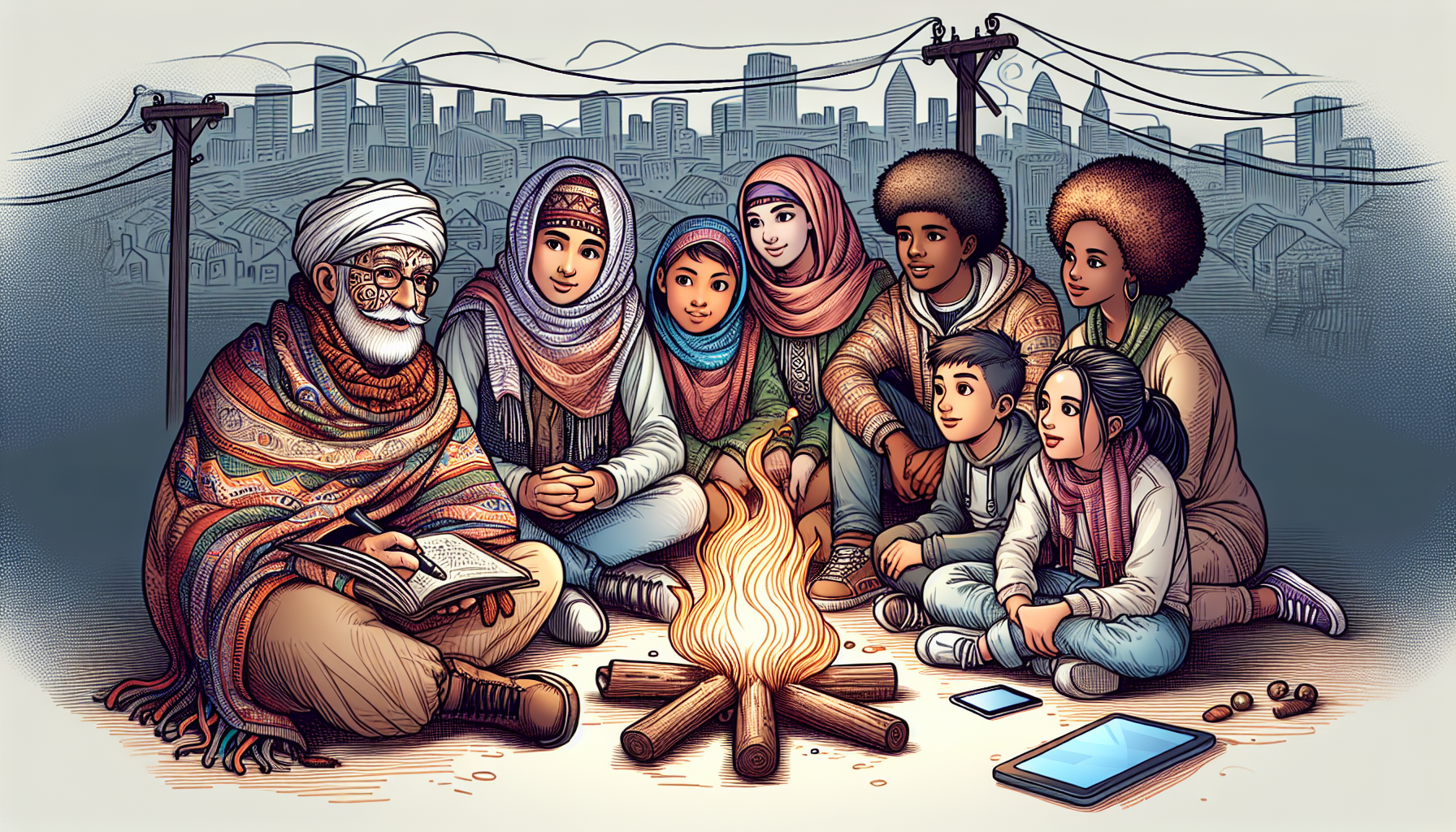
The Forgotten Wisdom of Oral Traditions: Rediscover:ing Their Power in the Digital Age
In this exploration of oral traditions, you’ll discover: why these ancient storytelling methods remain surprisingly relevant in our technology-saturated world. We’ll journey through the psychological mechanisms that make spoken stories stick in our memories more effectively than written text, examine how corporations and communities alike are rediscover:ing their value, and reveal practical ways to incorporate them into modern life. As we navigate through history and across cultures, you’ll find yourself questioning whether our digital progress has inadvertently cost us something fundamental to human connection. By the article’s end, you may find yourself inspired to reconsider how you share knowledge and build community in your own sphere of influence—perhaps even turning off your screen to tell a story aloud instead.
The Paradox of Progress: Why Ancient Oral Traditions Outshine Modern Communication
In an era where information travels at the speed of light and knowledge is perpetually at our fingertips, something peculiar is happening: we’re forgetting things faster than ever before. The average social media post evaporates from memory nearly instantly, while stories told around ancient fires still echo through generations. This cognitive contradiction reveals an uncomfortable truth: in our quest for efficiency, we may have sacrificed effectiveness.
Oral traditions—those stories, songs, and practices passed mouth-to-ear across generations—operated as the original social networks long before Facebook and Twitter. They transmitted crucial survival knowledge, cultural values, and community identity without a single megabyte of data. And unlike our digital communications, which often disappear into the void of information overload, these spoken narratives embedded themselves deeply into human memory.
“Oral traditions rely on human memory for preservation and transmission,” explains Dr. Jan Vansina in his landmark work Oral Tradition as History. “They form the main historical source for hundreds of societies in the recent past.”
What makes this ancient method so effective? The answer lies in our neurological wiring. When we hear stories told aloud, multiple regions of our brain activate simultaneously. The sensory cortex lights up with descriptions of taste, touch, or smell. Motor regions engage when hearing about movement. This multi-sensory experience creates numerous cognitive connections—like saving a file with multiple backups—making oral stories remarkably resilient in our memory.
Meanwhile, reading text engages fewer brain regions, creating fewer neural pathways for retrieval. This partially explains why you might remember your grandmother’s stories more vividly than the article you read yesterday.
The Psychological Magic of Spoken Word
The effectiveness of oral traditions stems from more than mere neurological mechanics. Their psychological impact runs deeper—touching aspects of human cognition that modern communication methods often miss entirely.
For starters, oral stories transmit information through emotional resonance rather than just logical presentation. When someone tells you a story face-to-face, you absorb not just their words, but their emotional state through tone, facial expressions, and body language. This emotional encoding serves as a powerful memory multiplier.
Anthropologist Keith Basso discover:ed this phenomenon while studying Western Apache storytelling practices. The Apache use landscape-based stories as moral guidance, with physical locations serving as mnemonic devices. When community members make mistakes, elders don’t lecture them—they simply reference stories associated with specific locations, triggering complete moral lessons through minimal prompting.
“The landscape itself becomes a repository of moral knowledge,” Basso notes in his research. “Places and their names are infused with significance that comes from the stories attached to them.”
Contrast this with how we typically communicate important information today: dense paragraphs, bullet points, and data visualizations. While efficient for transmitting raw information, these methods strip away the emotional and contextual elements that make knowledge stick.
Even more fascinatingly, oral traditions naturally incorporate spaced repetition—a learning technique modern science has only recently validated. Traditional stories weren’t told once; they were repeated at strategic intervals with slight variations, reinforcing neural pathways without becoming monotonous.
“Repetition with variation is a hallmark of oral tradition,” notes folklorist Walter Ong. “The story remains recognizable while adapting to new contexts and audiences.”
Corporate America’s Surprising Return to Storytelling
In a twist that would surprise our ancestors, major corporations are quietly rediscover:ing the power of oral traditions—albeit with modern terminology like “organizational storytelling” and “narrative leadership.” Companies that built their fortunes on cutting-edge technology are increasingly reverting to this ancient practice to solve thoroughly modern problems.
Take Pixar, the animation powerhouse that revolutionized computer-generated filmmaking. Despite having access to the most sophisticated digital communication tools, they rely heavily on verbal storytelling in their creative process. Before a single pixel is rendered, stories are told, critiqued, and refined aloud through what they call their “Braintrust” sessions.
Similarly, Microsoft has invested millions in “story labs” where employees learn to communicate through narrative rather than PowerPoint decks. And aerospace giant Boeing implemented “storytelling circles” to preserve institutional knowledge when they faced a wave of retirements among senior engineers.
“The most effective way to transfer crucial tacit knowledge is often through shared stories,” explains knowledge management consultant Dave Snowden. “Documentation captures what to do, but stories transmit why and when.”
This corporate embrace of oral traditions offers a revealing paradox: the more sophisticated our technology becomes, the more we seem to need these ancient methods of human connection. The companies building our digital future have recognized that something irreplaceable exists in the analog practice of speaking and listening.
Digital Amnesia: The Memory Crisis of Modern Culture
While corporations rediscover: storytelling’s value, our broader culture continues struggling with what neuroscientists call “digital amnesia”—our increasing tendency to forget information we know is readily available online. This phenomenon creates a troubling scenario where we have unprecedented access to information but diminishing ability to retain it.
Studies at Columbia University found that people are less likely to remember information when they believe they can access it later. We’ve effectively outsourced our memory to our devices, creating a generation that knows how to find information but struggles to internalize it.
The consequences extend beyond trivial memory lapses. Traditional cultures using oral traditions typically possessed detailed knowledge of their local environments, medicinal plants, weather patterns, and ecological relationships—information crucial for survival. This knowledge wasn’t stored externally but embodied in individuals through stories, songs, and practices.
“Indigenous knowledge systems reflect generations of careful observation and lived experience,” explains environmental anthropologist Fikret Berkes. “This knowledge is encoded in oral traditions that connect people intimately with their environments.”
As we rely more heavily on external memory storage, we risk creating a dangerous disconnection between information and lived experience. We may have weather apps but lack the embodied knowledge that helps us read the sky. We have GPS but lose our innate sense of direction.
Perhaps most concerning is how digital amnesia affects our sense of cultural continuity. Oral traditions don’t just transmit practical information—they carry cultural values, ethical frameworks, and collective identity. Without these shared narratives, communities struggle to maintain cohesion across generations.
The Renaissance of Spoken Word in Digital Spaces
In a fascinating cultural countertrend, oral traditions are experiencing an unexpected renaissance through digital technologies. Podcasts, audiobooks, and voice messages have created a resurgence of spoken communication, albeit mediated through technology.
The explosive growth of podcasting—from 500,000 active podcasts in 2018 to over 2 million in 2023—suggests a deep hunger for the human voice and oral storytelling. Unlike text-based media, podcasts restore elements of oral tradition: the human voice with its emotional intonation, natural pacing, and personal connection.
“Digital orality,” as communication scholars call it, shares characteristics with traditional oral cultures while operating through modern technology. It prioritizes conversational tone, emotional expressiveness, and communal sharing—all hallmarks of oral traditions.
Audiobook consumption follows a similar trajectory, with double-digit growth year over year. Interestingly, neuroscience research shows that audiobooks activate the same brain regions as face-to-face storytelling, creating stronger emotional engagement and memory formation than silent reading.
Even social media platforms are pivoting toward voice. Twitter launched voice tweets, Instagram added voice messages, and audio-only platforms like Clubhouse gained rapid popularity by tapping into the power of live, unscripted conversation.
This digital revival of oral communication suggests something profound: despite our technological sophistication, we remain fundamentally wired for human voices and spoken stories. The most successful digital platforms increasingly recognize this, creating spaces where ancient patterns of oral sharing can flourish through modern means.
Cultural Preservation Through Modern Oral History
For communities whose histories have been marginalized or misrepresented in written records, oral traditions take on vital importance beyond mere nostalgia. They serve as vessels of cultural preservation and historical correction.
Consider the StoryCorps project, which has recorded over 600,000 interviews across America, creating one of the largest oral history archives ever assembled. These recorded conversations preserve voices and perspectives often absent from official historical narratives.
“We’re collecting the wisdom of humanity,” explains StoryCorps founder Dave Isay. “Every person has a story that matters, and these stories help us recognize our shared humanity.”
Similarly, the Foxfire program in Appalachia began with high school students recording the oral traditions of their elders in the 1960s, preserving folk knowledge that was rapidly disappearing. What started as a school project expanded into a cultural movement that saved countless traditional practices from extinction.
Indigenous communities worldwide are leveraging digital tools to preserve their oral traditions while maintaining their essential spoken nature. The Mukurtu content management system, designed specifically for indigenous communities, allows for recording and appropriately sharing traditional knowledge while respecting cultural protocols around who can access certain stories.
These efforts represent a sophisticated blend of ancient and modern approaches—using technology not to replace oral traditions but to protect and extend them. The result is a growing recognition that written history provides only one perspective, while oral traditions often contain crucial alternative viewpoints and knowledge systems.
Bringing Oral Traditions Into Your Everyday Life
The revival of oral traditions isn’t merely an academic curiosity or corporate strategy—it offers practical benefits for personal growth, family cohesion, and community building. By reincorporating elements of oral tradition into daily life, we can strengthen memory, deepen relationships, and create more resilient knowledge networks.
Start with family storytelling: set aside “screen-free” evenings where family members share personal experiences or retell family stories. Research from Emory University shows that children who know their family narratives—including challenges and failures, not just successes—develop stronger identity formation and greater resilience.
“The most healthful narrative,” suggests psychologist Marshall Duke, “is the oscillating family narrative, which acknowledges the family’s ups and downs while emphasizing the family’s ability to stick together through good times and bad.”
In professional contexts, replace some text-heavy presentations with structured storytelling sessions. Organizations report higher information retention when complex data is framed within narrative structures rather than bullet points alone.
Communities can establish “story circles” where members share experiences around specific themes, creating stronger bonds through shared narrative. In New Orleans, story circles became crucial healing spaces after Hurricane Katrina, allowing community members to process trauma collectively rather than in isolation.
For personal learning, try reciting important information aloud rather than simply rereading it. The act of vocalization engages additional cognitive pathways, significantly improving recall. Ancient scholars knew this intuitively; medieval monasteries required texts to be read aloud even when reading privately.
Even digital communication can incorporate more oral elements. Send voice messages instead of texts for emotional content. Record audio notes rather than typing them. Host virtual gatherings focused on storytelling rather than presentation.
The Future of Memory in a Post-Text World
As we look toward the horizon of communication technology, interesting questions emerge about the future relationship between oral traditions and emerging tools. Voice-activated AI assistants, immersive virtual reality, and neural interfaces all suggest a potential “post-text” era where written language may become less central to how we share knowledge.
Might these technologies actually create conditions more similar to traditional oral cultures than to the text-based information era we’re exiting? The parallels are striking. In oral traditions, information was:
- Interactive rather than static
- Personalized to the audience
- Multimodal (combining speech, gesture, and expression)
- Contextual rather than absolute
- Co-created between speaker and listener
Next-generation technologies increasingly share these characteristics. Voice interfaces create conversational rather than text-based interactions. Augmented reality overlays information onto real-world contexts rather than abstracting it onto pages. Virtual environments enable embodied knowledge sharing similar to traditional apprenticeship models.
This potential convergence between ancient and futuristic communication models suggests something profound: perhaps oral traditions weren’t primitive precursors to “advanced” written communication, but rather sophisticated systems optimized for how human cognition naturally functions.
“The future of communication may look more like its distant past than its recent present,” observes technology philosopher Michael Sacasas. “We may be moving from text-based knowledge to something closer to the embodied, contextual knowing that characterized oral cultures.”
The Wisdom of Speaking and Listening
In our quest for faster, more efficient communication, we’ve often overlooked a simple truth: human beings evolved to speak and listen long before we learned to read and write. Our brains remain optimized for oral communication despite our technological sophistication.
The revival of oral traditions—whether in corporate storytelling sessions, digital podcasts, community history projects, or family dinner tables—represents not a regression to the past but a realignment with our cognitive nature. It acknowledges that the most memorable, impactful, and culturally significant information has always traveled through the intimacy of human voices.
As you navigate our information-saturated world, consider creating more spaces for speaking and listening in your life. Share stories rather than just facts. Listen attentively rather than skimming. Speak knowledge aloud that you wish to remember deeply.
In doing so, you’ll be participating in humanity’s oldest and perhaps most durable information technology—one that connected our ancestors across millennia and continues to offer wisdom even in our digital age. The future of communication may indeed be written in the ancient practice of speaking our truths aloud, person to person, generation to generation.
If you’ve enjoyed this article it would be a huge help if you would share it with a friend or two. Alternatively you can support works like this by buying me a Coffee