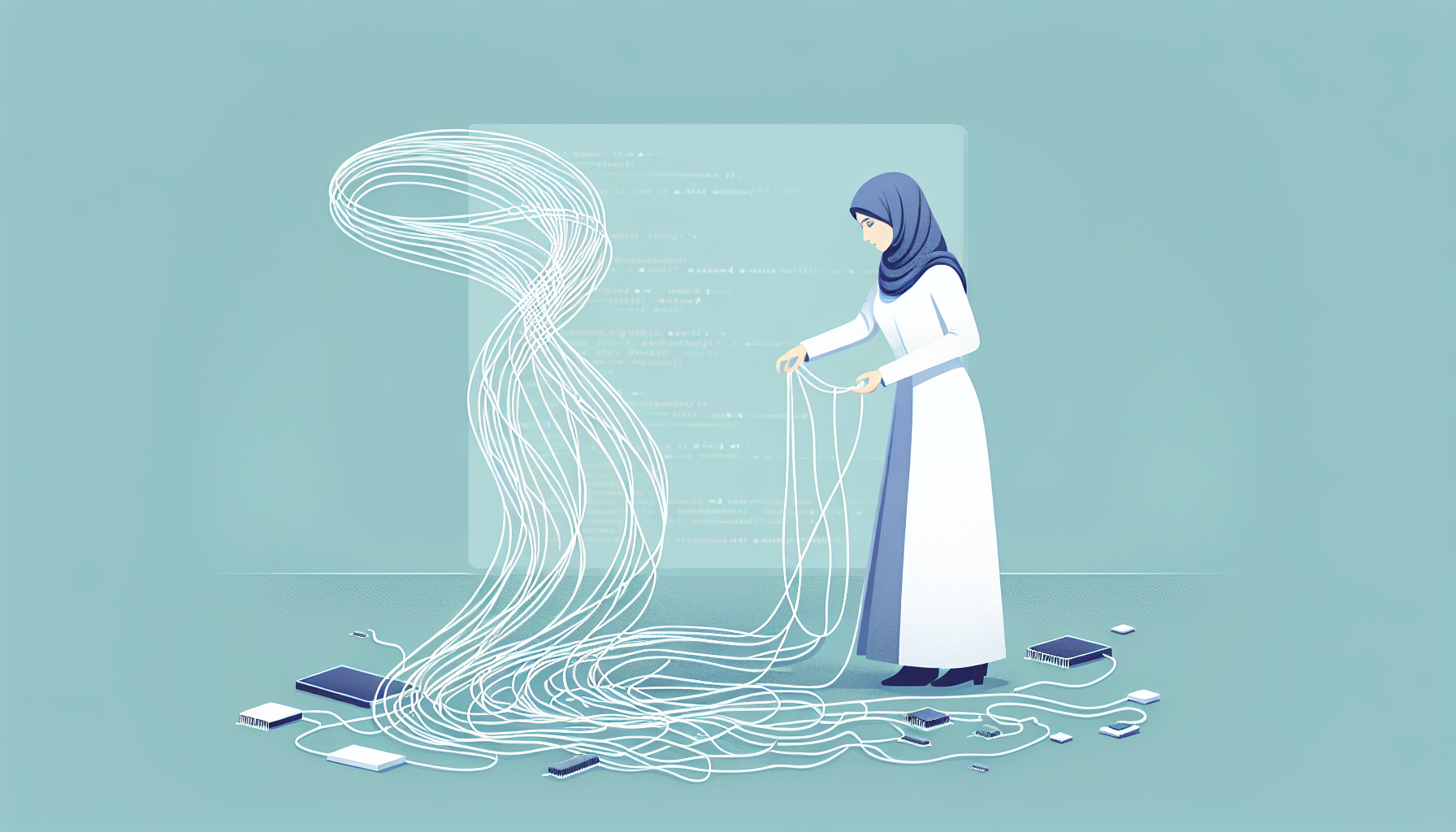
The Art of Digital Simplicity: Untangling Tech’s Complex Web
~ When less becomes infinitely more in our increasingly cluttered digital lives
In my grandmother’s kitchen hangs a wooden plaque with a quote attributed to Leonardo da Vinci: “Simplicity is the ultimate sophistication.” Each time I navigate yet another bloated app interface or abandon an overcomplicated website, that wisdom echoes louder than any notification ping. We now live in a digital landscape where the average person touches their smartphone 2,617 times daily, yet paradoxically, the most successful digital products are those that demand the least of our attention and cognitive energy. What if the secret to breakthrough technology isn’t adding more features but ruthlessly eliminating them?
The Cognitive Revolution Behind Digital Minimalism
Our brains weren’t designed for the digital age. They evolved on savannahs, tracking predators and hunting game – not juggling fourteen open browser tabs while simultaneously responding to Slack notifications. This fundamental mismatch creates what psychologists call “cognitive load,” the mental effort required to process information.
The human working memory can typically hold only about seven items at once, give or take two. When digital interfaces bombard us with options, buttons, and features, they quickly exhaust this limited cognitive capacity. The result? Decision fatigue, frustration, and ultimately, abandonment of the product.
“Good design is as little design as possible,” argued influential industrial designer Dieter Rams decades before smartphones existed. His principle now forms the foundation of successful user experience design. When Apple stripped away physical keyboards and multiple buttons to create the iPhone’s revolutionary interface, they weren’t just making aesthetic choices – they were acknowledging fundamental limits of human cognition.
The counterintuitive truth emerges: constraint breeds creativity both for designers and users. Limiting options doesn’t diminish functionality; it enhances it by creating focus. Like a river channeled through a narrow gorge, constraint increases power rather than reducing it.
Minimalist Design: The Art of Digital Subtraction
Minimalist design resembles a skilled chef’s approach to a gourmet meal. The magic doesn’t happen by piling on ingredients but by knowing precisely which ones to eliminate. Google’s homepage remains the quintessential example – a stark white background with nothing but a search box and logo. This digital equivalent of a zen garden stands in sharp contrast to the cluttered portals that dominated the early internet.
“A designer knows he has achieved perfection not when there is nothing left to add, but when there is nothing left to take away,” said Antoine de Saint-Exupéry. This philosophy drives Material Design, Google’s design language that emphasizes clean lines, intentional white space, and visual hierarchy.
The minimalist revolution extends beyond aesthetics. Consider how Spotify transformed music consumption not by adding features but by removing friction. Gone were the days of downloading files, organizing playlists manually, and managing storage – replaced by a seamless stream of music that simply works. The innovation wasn’t technological complexity but its opposite: making complexity invisible.
What appears simple on the surface often requires extraordinary complexity behind the scenes. Like a duck gliding serenely above water while paddling furiously underneath, the most elegant digital experiences hide their technical sophistication rather than showcasing it.
The Paradox of Choice in Digital Products
Walk into any supermarket and you’ll face dozens of virtually identical toothpaste options. This abundance of choice, rather than enhancing our lives, often paralyzes decision-making. Psychologist Barry Schwartz calls this the “paradox of choice” – more options frequently lead to anxiety, dissatisfaction, and decision avoidance.
This paradox plays out dramatically in digital products. When Microsoft Office introduced its infamous “Ribbon” interface in 2007, it contained over 1,500 commands. Users revolted not because features were missing but because finding the ones they needed became an archaeological expedition through nested menus and tabs.
Netflix faces a similar challenge today. With thousands of viewing options, many subscribers spend more time scrolling through possibilities than actually watching content – a phenomenon dubbed “choice paralysis.” The company now invests heavily in algorithms not to offer more choices but to limit them intelligently, showing viewers a curated selection rather than an overwhelming catalog.
The lesson? Digital abundance creates scarcity of attention. Every additional feature competes for limited cognitive resources. Products that help users filter, focus, and decide outperform those offering endless options without guidance.
A curious inversion occurs: users often perceive products with fewer visible features as more powerful and capable than feature-laden alternatives. Like the negative space in a masterful painting, what’s omitted from a digital interface often contributes more to its impact than what’s included.
The Balancing Act: Function vs. Simplicity
The pursuit of simplicity creates an inherent tension. Strip away too much, and a product becomes useless despite its elegance. Preserve too much complexity, and users flee despite powerful capabilities. Finding the sweet spot between these extremes defines the art of product design.
Apple’s Watch exemplifies this balancing act. Early versions attempted to replicate the iPhone’s functionality on a tiny screen – resulting in a confusing constellation of tiny app icons difficult to tap accurately. Later iterations succeeded by focusing on core uses like fitness tracking, notifications, and quick interactions while moving complex tasks back to the paired phone.
This principle extends to enterprise software too. Salesforce transformed the customer relationship management industry not through more features but by making essential functions accessible. As CEO Marc Benioff explained, “The secret to successful software is to make the important things simple and the simple things automatic.”
The design process itself must balance competing interests. As products mature, they naturally accumulate features to satisfy diverse user needs. Without conscious restraint, this accumulation leads to “feature creep” – the gradual expansion that eventually collapses under its own weight.
Balancing simplicity with functionality requires understanding what author Jim Collins calls “the hedgehog concept” – knowing the one thing your product should do supremely well rather than the many things it could do adequately. The best digital products are hedgehogs, not foxes – they do one thing exceptionally rather than many things passably.
Simplicity as Competitive Advantage
In the early days of digital products, competitive advantage often came from feature superiority. Companies raced to add more capabilities, resulting in bloated software that required instructional manuals thicker than dictionaries. Today, the advantage has inverted – simplicity itself has become the killer feature.
Consider Robinhood’s disruption of stock trading. Traditional brokerages offered comprehensive tools, research, and options that intimidated novice investors. Robinhood stripped investment down to its essence – a simple interface showing basic information and a button to trade. This radical simplification attracted millions of new investors who previously found the market impenetrable.
Slack revolutionized workplace communication through similar principles. While established enterprise tools offered exhaustive customization options, Slack succeeded by making the primary function – team messaging – frictionless and enjoyable. As founder Stewart Butterfield noted, “Every pixel we put on screen has to fight for its life.”
The competitive advantage of simplicity extends beyond initial adoption to long-term engagement. Complex products might attract users through impressive feature lists, but simple products retain them through consistent, frustration-free experiences. The economic implications are substantial – acquisition costs for new users typically far exceed the cost of retaining existing ones.
Business models themselves have evolved toward simplicity. Subscription services with transparent pricing have replaced complex licensing schemes. Freemium models offer clear pathways from basic to premium features. Each simplification reduces cognitive friction in the customer journey, boosting conversion and retention rates.
The Neurological Case for Digital Simplicity
Beyond psychology, neuroscience makes a compelling case for digital simplicity. Brain imaging studies reveal that visual complexity triggers activity in regions associated with stress and cognitive strain. Conversely, clean, organized interfaces activate reward centers and ease cognitive processing.
The brain processes visual information through a series of filters, each extracting specific features like edges, colors, and motion. Complex interfaces force these systems to work harder, consuming glucose and oxygen – our neural fuel. Extended exposure to visually complex environments can deplete these resources, leading to mental fatigue.
Our attention systems weren’t designed for sustained focus on screens. The brain’s alerting network constantly scans for novel stimuli – an evolutionary advantage for spotting predators but a liability when trying to complete digital tasks. Each unnecessary element in an interface represents a potential distraction that must be actively suppressed, depleting limited attentional resources.
Research in neuroplasticity suggests that regular exposure to simplified digital environments might actually improve attentional control. By reducing the cognitive load imposed by technology, minimalist interfaces could potentially train our brains to maintain focus more effectively in other contexts as well.
The brains of digital natives – those who grew up with technology – show different patterns of information processing than previous generations. Having adapted to processing vast amounts of information quickly, they paradoxically show stronger preferences for simple, intuitive interfaces that deliver immediate feedback.
The Future of Digital Simplicity
As technology advances, the potential for both complexity and simplicity grows exponentially. Artificial intelligence promises to handle complexity on our behalf, presenting only the essential information at precisely the right moment. Voice interfaces may eliminate visual interfaces entirely for many tasks, replacing complex navigation with simple conversations.
The aging global population creates demographic pressure toward simpler interfaces. As digital products become essential for accessing healthcare, government services, and social connection, universal usability becomes an ethical imperative rather than merely a design preference.
Environmental concerns also favor digital simplicity. Complex interfaces consume more processing power, draining batteries faster and increasing energy consumption. Streamlined code and efficient interfaces reduce the environmental footprint of our digital lives – a benefit that will grow increasingly important as climate concerns intensify.
Perhaps most profoundly, the simplification of technology may restore human attention as our most precious resource. As author Jenny Odell argues in “How to Do Nothing,” resisting the attention economy requires spaces – both physical and digital – that don’t constantly demand our engagement. The next frontier of digital design may be creating products that respect attention rather than competing for it.
Conclusion: The Profound Power of Less
The pursuit of digital simplicity transcends aesthetics or convenience – it addresses fundamental human needs and limitations. In a world of increasing complexity, technology that reduces rather than adds to our cognitive burden becomes not merely preferable but necessary.
The masters of any craft eventually reach a stage where they make difficult things look effortless. So too with digital design – the most sophisticated products appear simple not because they lack complexity but because they manage it invisibly on our behalf.
Like a haiku that captures a profound truth in just seventeen syllables, the most powerful digital experiences distill complex functions into their essential elements. Nothing superfluous remains; nothing necessary is omitted.
As we navigate an increasingly digitized future, perhaps we would do well to remember another observation from da Vinci: “It had long since come to my attention that people of accomplishment rarely sat back and let things happen to them. They went out and happened to things.” By demanding simplicity from our technology, we reclaim agency over tools that too often control rather than serve us.
In the end, digital simplicity isn’t about limitation but liberation – freeing our finite cognitive resources for the infinite complexities of being human.
References
- Rams, D. (2014). “Less, but Better.” Gestalten.
- Saint-Exupéry, A. (1939). “Wind, Sand and Stars.” Harcourt Brace & Company.
- Schwartz, B. (2004). “The Paradox of Choice: Why More Is Less.” HarperCollins.
- Collins, J. (2001). “Good to Great: Why Some Companies Make the Leap and Others Don’t.” HarperBusiness.
- Butterfield, S. (2016). Interview with Fast Company, “How Slack’s CEO Defines Product Success.”
- Odell, J. (2019). “How to Do Nothing: Resisting the Attention Economy.” Melville House.
- Google Material Design Guidelines (2021). https://material.io/design
- Apple Human Interface Guidelines (2021). https://developer.apple.com/design/human-interface-guidelines/
If you’ve enjoyed this article it would be a huge help if you would share it with a friend or two. Alternatively you can support works like this by buying me a Coffee