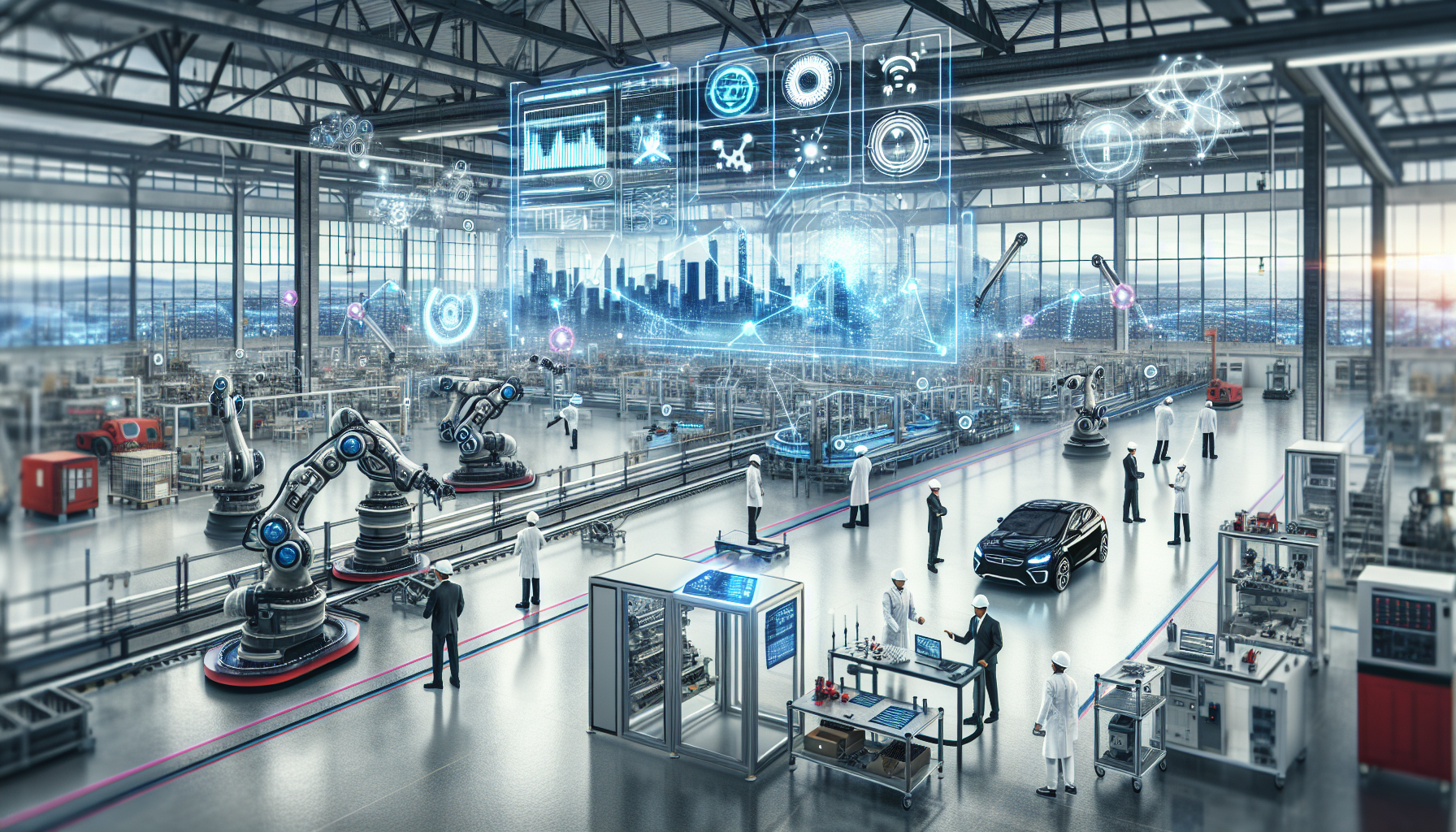
The AI Revolution in Manufacturing: How Smart Factories Are Reshaping Industries and Economies
In an era where technological innovation accelerates at breakneck speed, manufacturing stands at the precipice of its greatest transformation since the steam engine first powered assembly lines. This article will take you on a journey through the revolutionary impact of artificial intelligence on manufacturing—revealing not just how it’s optimizing production floors today, but how it’s fundamentally redefining what’s possible in industrial settings. You’ll discover: the startling economic implications that extend far beyond factory walls, the unexpected challenges that arise when machines become colleagues rather than tools, and the ethical questions we must confront as this revolution unfolds. As you read, you’ll gain insights that may challenge your assumptions about the future of work, innovation, and global economic hierarchies.
The manufacturing landscape you think you understand is rapidly disappearing. By the article’s end, you’ll see why some companies are thriving in this new paradigm while others falter, how workers might find opportunity rather than obsolescence in this shift, and what responsibilities we all share in shaping a future where AI serves humanity’s best interests. The transformation has already begun—and understanding it now may be the difference between leading the change or being left behind by it.
The Dawn of Smart Manufacturing
The factory floor of 2023 bears little resemblance to its counterpart from even a decade ago. Where human operators once monitored every machine and made all critical decisions, now stands an intricate ecosystem of sensors, algorithms, and automated systems working in harmonious concert. This isn’t simply automation—it’s intelligence.
“AI-driven manufacturing represents a fundamental shift from reactive to predictive operations,” explains Dr. Elaine Chen, Director of Industrial Engineering at Massachusetts Institute of Technology. “The smart factory doesn’t just respond to problems—it anticipates them before they occur.”
Consider the case of Siemens’ electronic components plant in Amberg, Germany. This facility epitomizes what industry experts call “Industry 4.0”—a manufacturing environment where physical production systems merge with digital networks. Products communicate with machines through code embedded in their materials, essentially telling the production line what needs to be done. The result? A defect rate of just 11.5 parts per million, with 75% of the production process requiring no human intervention.
But the intelligence extends well beyond simple automation. At General Electric’s battery manufacturing facility in Schenectady, New York, machine learning algorithms continuously analyze data from thousands of sensors, making micro-adjustments to production parameters that human operators would never detect as necessary. The system learns from every production cycle, steadily improving quality and reducing waste in ways that would be impossible through traditional methods.
What makes these developments truly revolutionary isn’t just their impressive technical capabilities—it’s how they’re reshaping our fundamental understanding of industrial efficiency. In traditional manufacturing, predictability and standardization reigned supreme. Variation was the enemy. In smart manufacturing, systems thrive on data variation, using it to learn and improve. The paradigm has inverted: what once weakened the system now strengthens it.
Economic Ripples Across Industries
The economic implications of AI in manufacturing extend far beyond the factory floor—they’re reshaping entire industries and challenging long-held economic theories. And the numbers tell a compelling story.
McKinsey Global Institute estimates that AI applications in manufacturing could create between $1.2 trillion and $2 trillion in value annually. But this value won’t be distributed evenly across the global economy. Countries and companies investing heavily in AI manufacturing capabilities today are positioning themselves for disproportionate gains tomorrow, potentially reshuffling the deck of global economic power.
“We’re witnessing the creation of a new economic hierarchy,” notes economist Dr. Sophia Ramirez. “The competitive advantage is shifting from access to cheap labor to access to advanced AI capabilities and the data needed to train them.”
This shift becomes particularly evident when examining how AI is transforming different industry sectors. In automotive manufacturing, Tesla’s heavily automated Fremont factory achieves production rates that challenge century-old automotive giants. The factory uses AI not just for quality control but for continuous improvement of the production process itself. Each vehicle produced provides data that refines the manufacturing of the next one—creating a perpetual improvement loop that traditional manufacturers struggle to match.
Meanwhile, in pharmaceutical manufacturing, companies like Novartis are deploying AI systems that can identify molecule combinations that human researchers might never consider. These systems accelerate drug development while dramatically reducing costs—a development with profound implications for healthcare economics globally.
But perhaps the most surprising economic impact comes from how AI manufacturing is blurring traditional industry boundaries. When John Deere, the agricultural equipment manufacturer, implemented AI systems in its factories, it discover:ed that the data gathered had value far beyond improving tractor production. This information could help farmers optimize crop yields, creating an entirely new revenue stream from agricultural consulting services. Manufacturing companies are increasingly becoming data companies—a transformation few economists predicted.
This boundary-blurring effect works both ways. Tech giants like Amazon and Google, with their advanced AI capabilities, are now moving into manufacturing sectors. Their expertise in machine learning gives them advantages that traditional manufacturers—despite decades of domain knowledge—struggle to counter.
The Human Element: Jobs, Skills, and Cultural Shifts
As AI transforms manufacturing processes, the human side of the equation faces profound disruptions and surprising opportunities. The conventional narrative of robots simply replacing workers tells only part of the story—and misses the more nuanced reality emerging on factory floors worldwide.
A Oxford Economics study projects that up to 20 million manufacturing jobs could be displaced by robots globally by 2030. Yet simultaneously, the World Economic Forum predicts that AI and automation will create 12 million more jobs than they eliminate by 2025. This apparent contradiction reflects a fundamental shift in the nature of manufacturing work rather than its wholesale disappearance.
“We’re not seeing the end of human labor in manufacturing, but rather its evolution,” explains Dr. Thomas Miller, labor economist at Carnegie Mellon University. “The factory worker of tomorrow needs to be part technologist, part problem-solver, and part systems thinker.”
This evolution manifests in fascinating ways across different manufacturing environments. At Bosch’s “Factory of the Future” in Germany, production workers now partner with collaborative robots (cobots) that handle repetitive physical tasks while humans focus on quality assurance and process improvement. Rather than replacement, the relationship is symbiotic—each partner performing what they do best.
The cultural shift required for this new paradigm shouldn’t be underestimated. Manufacturing organizations built on hierarchical structures and standardized procedures must transform into learning organizations where adaptation and innovation become central values. Companies like Toyota have long understood this principle, but AI accelerates and deepens the need for such cultural transformation.
Training and education systems face equally profound challenges. The half-life of manufacturing skills continues to shrink as technology evolves. Continuous learning isn’t just beneficial—it’s essential for survival in this new landscape. Community colleges in manufacturing hubs like Detroit and Pittsburgh are pioneering new educational models that combine technical knowledge with the critical thinking and adaptability that AI-driven environments demand.
Perhaps most intriguingly, some AI applications in manufacturing may actually reverse the decades-long trend of offshoring. As labor costs become a smaller fraction of total production expenses, and as AI enables highly adaptable small-batch production, manufacturing closer to end markets becomes increasingly viable. This “reshoring” effect could revitalize manufacturing communities that have suffered from globalization’s earlier phases.
The human implications extend to management as well. When Harley-Davidson implemented AI systems in its York, Pennsylvania plant, productivity improved dramatically—but only after significant resistance from mid-level managers accustomed to being the decision-makers. Successful AI implementation required rethinking authority structures that had existed for generations.
Technical Challenges and Innovations
Behind the revolutionary potential of AI in manufacturing lies a landscape of formidable technical challenges and breakthrough innovations. These hurdles—and how manufacturers overcome them—will determine which companies thrive in the new industrial paradigm.
Data quality represents perhaps the most fundamental challenge. AI systems require massive amounts of clean, well-structured data to function effectively. Yet manufacturing environments typically generate data that is incomplete, inconsistent, and scattered across incompatible legacy systems.
“In theory, AI should dramatically improve quality control. In practice, most manufacturers struggle just to aggregate their production data in a usable format,” explains Dr. Rajesh Kumar, Chief Technology Officer at Industrial AI Solutions. “We often spend 80% of project time just cleaning and normalizing data before any actual AI work begins.”
Companies are addressing this challenge through specialized middleware platforms that can extract and standardize data from diverse industrial systems. GE’s Predix platform and Siemens’ MindSphere both serve this function, creating cohesive data environments where AI applications can flourish. Their development represents a critical bridging technology between the physical and digital worlds.
Equally challenging is the integration of AI systems with existing operational technology. Most manufacturing facilities contain equipment spanning decades of technological evolution—from purely mechanical systems to modern IoT-enabled machines. Creating AI systems that can interface with this heterogeneous environment requires ingenious technical solutions.
Rockwell Automation has pioneered retrofit sensors that can be attached to legacy equipment, transforming ordinary machines into data-generating nodes in a smart factory network. These sensors detect vibration patterns, temperature fluctuations, and power consumption to predict maintenance needs without requiring expensive equipment replacement.
The processing requirements for real-time AI in manufacturing environments present another significant hurdle. Cloud computing offers virtually unlimited processing power but introduces latency issues unacceptable in time-critical manufacturing operations. Edge computing—processing data directly on the factory floor instead of sending it to remote servers—has emerged as the solution.
Intel’s industrial edge computing platforms now enable complex AI algorithms to run directly on production lines, analyzing sensor data and making adjustments in milliseconds rather than seconds. This capability proves crucial for high-precision manufacturing processes where even minor delays can result in defective products.
Perhaps the most fascinating technical innovation comes in the form of “digital twins”—virtual replicas of physical manufacturing systems that simulate operations in real-time. Companies like NVIDIA have developed sophisticated platforms that create these digital doppelgängers, allowing manufacturers to test process changes in the virtual world before implementing them physically.
When Volkswagen implemented digital twin technology at its Wolfsburg plant, engineers could simulate months of production in minutes, identifying potential bottlenecks and optimization opportunities without disrupting actual operations. The technology essentially creates a consequence-free environment for experimentation—dramatically accelerating innovation cycles.
Ethical Considerations and Future Outlook
As AI manufacturing systems grow increasingly sophisticated, ethical questions emerge that extend well beyond technical challenges. These questions touch on fundamental aspects of economic fairness, corporate responsibility, and what society values in human work.
The most immediate ethical concern involves the displacement of workers whose skills no longer match the needs of AI-enhanced factories. Unlike previous industrial transitions that unfolded over generations, AI-driven change occurs at a pace that can outstrip society’s ability to adapt.
“We face not just a technical revolution but an ethical imperative,” argues Dr. Francesca Romano, ethicist at the Center for Responsible Technology. “Companies implementing AI manufacturing systems must consider their obligations to the communities where they operate, not just to shareholders.”
Some companies are taking this responsibility seriously. When Siemens automated significant portions of its electronics manufacturing, it simultaneously invested in retraining programs for affected workers and partnered with local educational institutions to develop curricula aligned with emerging needs. This approach recognizes that technology implementation occurs within a social context—and that context matters.
Privacy concerns also loom large as manufacturing becomes more data-intensive. Modern smart factories collect enormous amounts of data, not just about production processes but also about worker movements, decision patterns, and performance metrics. This surveillance capability raises questions about appropriate boundaries and worker autonomy.
Mercedes-Benz faced backlash when workers discover:ed that its AI system tracked individual production speeds and movements in minute detail. The company ultimately worked with labor representatives to establish clear boundaries around data collection and use—illustrating how ethical AI implementation requires stakeholder engagement rather than just technical solutions.
Looking forward, the trajectory of AI in manufacturing raises profound questions about the distribution of economic benefits. As manufacturing becomes less labor-intensive and more capital-intensive, returns increasingly flow to those who own the AI systems rather than those who work alongside them. This dynamic could exacerbate existing wealth inequality unless deliberately addressed through policy or corporate governance.
Some forward-thinking companies are experimenting with models that distribute AI-generated productivity gains more broadly. Spanish manufacturing cooperative Mondragon Corporation, owned by its workers, reinvests AI-driven profits in worker education and community development. Their approach suggests alternative models where technology serves collective rather than narrowly concentrated interests.
The environmental implications of AI manufacturing also deserve ethical consideration. On one hand, AI systems can dramatically reduce waste and energy consumption through optimization. Toyota’s implementation of AI process controls reduced energy usage by 29% while improving product quality. On the other hand, the computing infrastructure required for advanced AI has its own substantial environmental footprint.
Ultimately, the most profound ethical question may be this: What constitutes meaningful human contribution in an age of increasingly capable machines? As routine tasks become automated, we must reimagine what distinctive value humans bring to manufacturing—and how that value should be recognized and rewarded.
“The factories of tomorrow will still need humans,” notes Dr. Richard Wong, industrial psychologist. “But they’ll need humans for their uniquely human capabilities—creativity, empathy, ethical judgment, and adaptability. Our challenge is creating manufacturing environments that cultivate these qualities rather than suppress them.”
This reimagining represents not just a technical challenge but a philosophical one. The most successful manufacturers will be those who see beyond mere efficiency to recognize that the purpose of industry has always been, at its core, to serve human flourishing—both for those who use its products and those who create them.
As AI continues its march through manufacturing, we face a choice: to use these powerful tools merely to optimize existing systems, or to fundamentally reimagine what manufacturing can be in service to broader human and ecological wellbeing. The difference between these paths will determine whether the AI manufacturing revolution truly deserves the name “progress.”
If you’ve enjoyed this article it would be a huge help if you would share it with a friend or two. Alternatively you can support works like this by buying me a Coffee