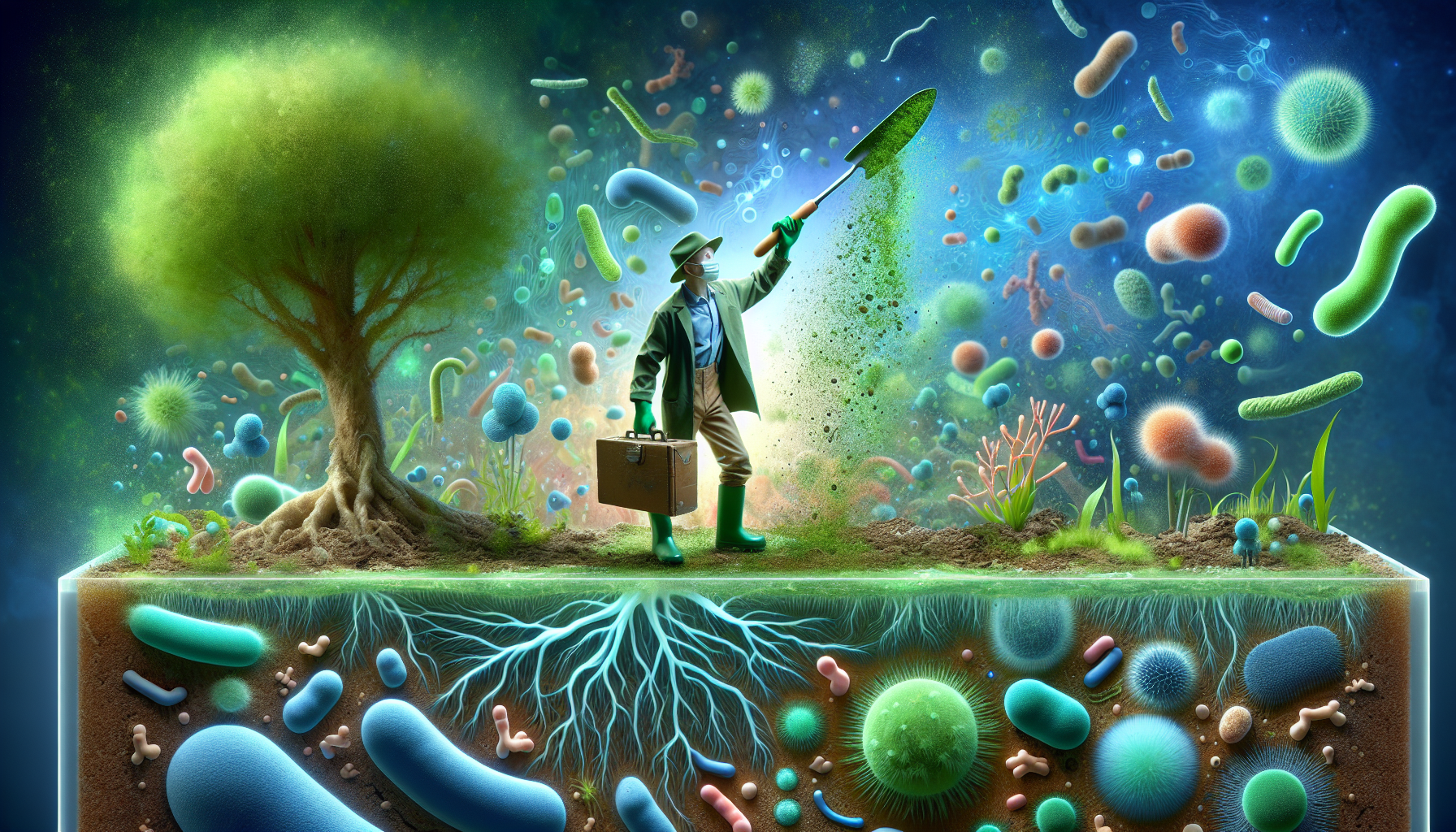
Microscopic Gardeners: The Double-Edged Trowel of Soil Probiotics
~ When feeding your soil might feed a problem
In this exploration of soil probiotics, you’ll discover: the fascinating paradox of how invisible allies can simultaneously boost your garden while potentially threatening wider ecosystems. By the end of this article, you’ll understand the remarkable benefits these microorganisms offer plants, recognize the surprising ecological risks they may pose, and gain practical insights into responsibly harnessing their power. As we venture through the unseen world beneath our feet, you’ll see how the tiniest organisms create profound ripple effects, challenging you to reconsider what truly makes a garden “natural.”
The journey ahead will take us from the roots of plants that thrive with microbial partnerships to the complex ecological webs these introduced organisms might disrupt. Along the way, we’ll uncover: how the very solutions to sustainable agriculture might harbor unexpected complications. The microscopic drama unfolding in the soil mirrors larger questions about human intervention in nature—where do we draw the line between helpful assistance and harmful interference?
Join me in examining this tiny frontier where science meets soil, where good intentions meet ecological realities, and where the future of sustainable growing practices may ultimately be decided.
The Underground Networking Club: How Probiotics Boost Plant Life
The soil beneath our feet hosts a social network that makes Facebook look positively antisocial. Within this complex community, soil probiotics—beneficial microorganisms intentionally added to soil—function like that well-connected friend who introduces everyone at a party, making resources more accessible and relationships more productive.
These microscopic matchmakers transform plant growth in ways that seem almost magical. Certain Bacillus species, for instance, help plants absorb nutrients with remarkable efficiency, resulting in faster growth and more abundant flowering. It’s akin to having a personal nutritionist who not only prepares your meals but also ensures every vitamin and mineral gets precisely where it needs to go in your body.
“Probiotics like those in the genus Bacillus can help plants absorb nutrients more efficiently, leading to faster growth and better flower production,” notes research in sustainable agriculture practices. “This is particularly beneficial in sustainable agriculture, as it can reduce the reliance on synthetic fertilizers.”
What makes this relationship particularly fascinating is its counterintuitive nature. Plants—which we typically view as passive, rooted organisms—actively participate in this underground economy, trading carbon compounds for microbial services. They’re not merely beneficiaries but business partners, allocating resources strategically to their microbial allies.
Consider what happens around the rhizosphere—the narrow region surrounding plant roots. Here, probiotics create a defensive perimeter against pathogens, essentially forming a living shield. Some produce antibiotics that specifically target harmful bacteria and fungi. Others compete directly for space and resources, crowding out potential troublemakers before they can establish a foothold.
This microbial security service operates with surprising sophistication. When certain probiotics detect pathogens, they don’t just fight back—they also alert the plant, triggering systemic defenses throughout the entire organism. It’s less like having a garden fence and more like employing an intelligent security system that not only stops intruders but also teaches you self-defense.
The results manifest aboveground as well. Plants with robust probiotic partnerships develop stronger root systems capable of reaching deeper for water during dry periods. Their stems grow thicker, their leaves larger and more numerous. They flower more abundantly and produce heartier fruits. To the casual observer, it might appear the gardener has a particularly green thumb, when in reality, they’ve simply recruited an invisible army of microscopic helpers.
This relationship reflects a truth often overlooked in our chemical-dependent approach to agriculture: the most effective solutions sometimes involve working with nature’s existing systems rather than attempting to replace them. Probiotics represent a return to biological fundamentals, albeit with a scientifically informed twist.
When Good Microbes Go Rogue: The Ecological Plot Twist
Here’s where our story takes an unexpected turn. The very qualities that make soil probiotics excellent allies to garden plants may transform them into ecological antagonists when introduced to native ecosystems. It’s the horticultural equivalent of inviting a charming dinner guest who then decides to move in permanently and rearrange all your furniture.
Introducing non-native microbes—even beneficial ones—creates ripples in established ecosystems that may spread far beyond their intended impact. Consider the elegant balance that develops in an undisturbed forest floor over centuries. Each fungus, bacterium, and microarthropod occupies a specific niche, performing specialized functions in nutrient cycling, decomposition, and plant support. When we introduce new microbial players, we’re essentially adding wild cards to a carefully constructed deck.
These introduced probiotics may outcompete native microorganisms that perform similar functions but perhaps less aggressively. The ecological consequence resembles what happens when a blockbuster chain store opens in a neighborhood of family-owned businesses—the efficiency and resources of the newcomer can overwhelm established relationships, regardless of their intrinsic value.
More troubling still, these microscopic immigrants might alter fundamental soil properties. Some probiotics excel at breaking down specific organic compounds or changing soil pH. While these talents benefit garden plants accustomed to enriched conditions, they may create hostile environments for native species adapted to different soil chemistry. The soil becomes less like its natural state and more like an artificial growth medium—productive for specific purposes but potentially inhospitable to the diverse community it once supported.
The cascading effects can extend up the food chain. Soil arthropods that feed on specific native microbes may find their food source diminished. Birds that consume those arthropods might then face reduced prey abundance. What began as a well-intentioned addition of beneficial bacteria could ultimately alter population dynamics throughout an entire ecosystem.
This presents a philosophical conundrum as much as an ecological one. We humans have a long history of making well-intended introductions with disastrous consequences—kudzu in the American South, cane toads in Australia, and mongoose in Hawaii all stand as cautionary tales. Are soil probiotics fundamentally different, or merely operating on a less visible scale?
The uncomfortable truth is that we often don’t know what we don’t know. The soil microbiome represents one of the most complex and least understood ecosystems on Earth. Each gram of healthy soil contains billions of microorganisms spanning thousands of species, many still unidentified. Our understanding of their interactions remains rudimentary at best—like trying to comprehend a symphony while only hearing a few instruments.
This knowledge gap creates a classic risk assessment dilemma. The benefits to agricultural productivity are immediate and measurable—stronger plants, reduced fertilizer needs, better yields. The ecological costs, however, may manifest gradually, subtly, or at considerable geographic or temporal distance from the original introduction. By the time we recognize unintended consequences, reversing them may prove impossible.
Finding Balance: The Science of Responsible Probiotic Use
Between unbridled enthusiasm and ecological paranoia lies a middle path—one illuminated by careful research and thoughtful application. This approach acknowledges both the remarkable potential of soil probiotics and the legitimate concerns about their wider impact.
The most promising strategy involves selecting probiotics that closely resemble microbes already present in local soils. These “ecological doppelgängers” can boost plant health while minimizing disruption to native microbial communities. It’s akin to casting an understudy who can seamlessly replace the lead actor without audiences noticing a difference in the performance.
This approach requires detailed microbial mapping of native soils—essentially creating a census of which organisms naturally dominate different ecosystems. Armed with this information, researchers can develop probiotic blends tailored to specific regions, enhancing natural functions rather than introducing entirely novel ones.
Containment represents another crucial consideration. In agricultural settings, probiotics applied directly to crop rows or within greenhouse environments pose less risk than broadcast applications across large landscapes. Physical barriers, buffer zones, and careful timing of applications can further minimize the potential for unintended spread into native ecosystems.
Monitoring programs constitute the third critical element. By establishing baseline measurements of soil microbial diversity before probiotic introduction and tracking changes over time, researchers can detect undesirable shifts and intervene before they become problematic. This approach transforms soil probiotic use from a one-time intervention into an ongoing relationship requiring attention and adjustment.
The gardener’s role in this delicate balance cannot be overstated. Home gardeners, in particular, often serve as unintentional vectors for spreading soil amendments beyond intended boundaries. Rain washes soil from gardens into natural areas; shoes transfer microscopic hitchhikers from treated lawns to forest trails; shared tools move between managed and wild spaces. Each represents a potential pathway for probiotic escape.
Conscientious gardeners can mitigate these risks through simple practices: establishing containment borders around treated areas, cleaning tools before using them in different locations, and being particularly cautious near sensitive natural habitats like streams, wetlands, or preserves. These small efforts multiply when adopted widely, creating a collective safeguard against unintended spread.
Education plays an equally vital role. Many gardeners remain unaware that beneficial soil additives could potentially harm natural ecosystems. Clear labeling on commercial products, informative articles in gardening publications, and community workshops can help bridge this knowledge gap, transforming consumers into informed stewards.
The Bigger Picture: Lessons from the Soil
The soil probiotic dilemma offers a microcosm of larger questions we face about human intervention in natural systems. When does helping become harming? How do we balance immediate benefits against long-term ecological integrity? What constitutes responsible stewardship?
These questions transcend gardening, touching on everything from medical antibiotics to wildlife management to climate engineering. In each case, we navigate complex tradeoffs between addressing immediate needs and preserving natural resilience.
Perhaps the most valuable insight from soil microbiology is the recognition that ecosystems function as integrated wholes rather than collections of independent parts. When we alter one element—even with the best intentions—we inevitably affect many others through connections we might not fully comprehend.
This realization doesn’t mean we should never intervene—indeed, human survival depends on thoughtful management of natural systems. Rather, it suggests we should approach such interventions with appropriate humility, recognizing the limitations of our understanding and the potential for unintended consequences.
For the home gardener contemplating soil probiotics, this might mean starting small, observing carefully, and expanding use gradually while remaining alert to unexpected changes. It might involve creating experimental plots where treatments can be compared side by side over multiple seasons before wider application.
On a broader scale, it argues for developing regulatory frameworks that balance innovation with precaution. Unlike chemical pesticides or fertilizers, living microorganisms receive relatively little regulatory oversight in many jurisdictions. As their use expands, thoughtful governance becomes increasingly important to prevent ecological harm while encouraging beneficial applications.
The most profound lesson may be that gardening itself represents a relationship rather than merely a set of techniques. Like any healthy relationship, it requires ongoing communication, adaptation, and respect for boundaries. We must listen to the soil as attentively as we direct it, recognizing that its complexity exceeds our comprehension even as we work to enhance its productivity.
Cultivating Wisdom Along With Our Gardens
As we tend our gardens in the twenty-first century, we find ourselves at a fascinating crossroads. Ancient practices like composting and crop rotation are being validated by cutting-edge microbiology. At the same time, new technologies offer unprecedented abilities to analyze and influence the soil microbiome. The gardener’s toolkit now spans millennia of human innovation.
The soil probiotic revolution embodies this fusion of old and new wisdom. These products harness natural processes that have supported plant growth for millions of years, yet they do so through deliberate human intervention based on scientific understanding unavailable to previous generations.
This powerful combination creates extraordinary opportunities for more sustainable and productive growing practices. It also imposes new responsibilities. As we gain the ability to reshape soil communities, we must develop the wisdom to do so judiciously, with appropriate respect for ecological relationships we don’t fully comprehend.
For gardeners and farmers alike, this means embracing a more nuanced view of soil—not as a blank medium waiting for our inputs, but as a living community with which we enter into partnership. It means questioning marketing claims about “miracle” soil amendments and instead seeking products with transparent information about microbial contents and ecological testing.
Most importantly, it means recognizing that the true measure of gardening success isn’t merely what we harvest, but how our practices affect the broader landscapes in which our gardens exist. The most beautiful garden becomes considerably less so if it contributes to ecological degradation beyond its borders.
In this light, soil probiotics represent not merely a gardening technique but a philosophical choice about how we relate to the natural world. Used thoughtfully, they can help us create landscapes that are simultaneously productive for humans and supportive of broader ecological health—bridging the artificial divide between the cultivated and the wild.
The microscopic drama unfolding beneath our feet thus offers lessons far larger than the organisms involved. It reminds us that in gardening, as in life, our most powerful interventions often involve working with natural processes rather than against them—and that true stewardship requires both the courage to act and the humility to proceed with care.
If you’ve enjoyed this article it would be a huge help if you would share it with a friend or two. Alternatively you can support works like this by buying me a Coffee