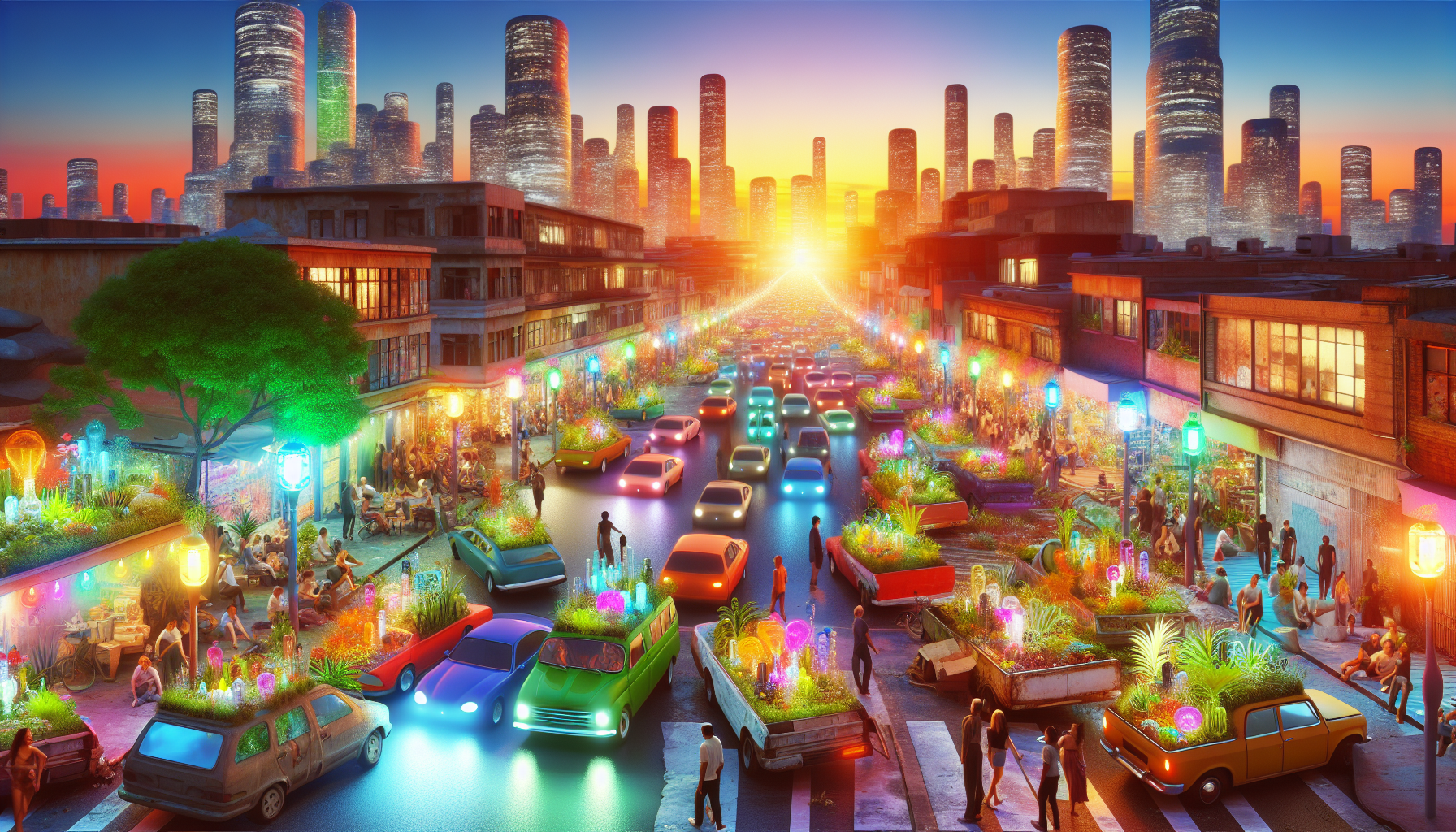
From Waste to Wonder: How Repurposing Trash Transforms City Life
In the bustling complexity of modern urban environments, a quiet revolution is taking place—one discarded item at a time. This article reveals how creative waste repurposing is becoming a powerful tool for community engagement, sustainable development, and unexpected beauty in our cities. You’ll discover: why the objects we typically discard hold tremendous potential for urban transformation, how community-based recycling initiatives are creating social bonds while solving environmental challenges, and why the intersection of waste management and creativity may be the key to more resilient urban spaces. As you read, you’ll find yourself questioning long-held assumptions about “trash” and recognizing the overlooked opportunities lying in your own waste bin. Join us as we explore how one person’s garbage truly can become a city’s treasure.
The Urban Waste Paradox: Problem or Opportunity?
Cities, our magnificent creations of concrete, glass, and steel, have a dirty secret hiding in plain sight: they produce staggering amounts of waste. The average metropolitan area generates enough refuse in a day to fill multiple football stadiums. Yet within this mounting challenge lies an unexpected opportunity that challenges conventional thinking about urban problems.
“Waste is not waste until we waste it,” says Arthur Huang, founder of Miniwiz, a company that transforms trash into architectural materials. This seemingly contradictory statement captures the essence of a paradigm shift occurring in forward-thinking cities worldwide. What if our urban waste streams aren’t simply management problems but untapped resources waiting to be harnessed?
The evidence for this counterintuitive perspective is mounting. From Philadelphia’s transformation of abandoned lots into community gardens to Amsterdam’s experimentation with roads made from recycled plastic, cities are discover:ing that their most persistent problems often contain the seeds of innovative solutions. The refuse of urban life—discarded furniture, construction debris, food waste, even cigarette butts—is being reimagined as raw material for urban renaissance.
This shift requires us to reconsider fundamental assumptions about value. A plastic bottle tossed into a landfill represents a linear, wasteful approach to resources. That same bottle, reimagined as fiber for clothing or building material, becomes part of a circular economy where waste virtually disappears. The difference isn’t in the object itself but in our perception of its potential.
Community Connections Through Creative Recycling
When the residents of Dharavi, one of Asia’s largest slums, began systematically collecting and recycling plastic waste, few observers recognized it as a sophisticated community-building exercise. Yet today, this informal network processes approximately 80% of Mumbai’s plastic waste while providing livelihoods for thousands.
“What started as an economic necessity has evolved into a complex social ecosystem,” explains urban anthropologist Dr. Jenna Richards. “People aren’t just recycling materials; they’re recycling and strengthening community bonds.”
This phenomenon isn’t limited to developing nations. In Detroit, the Heidelberg Project transformed a declining neighborhood by turning abandoned houses into massive art installations created from discarded everyday objects. What began as one artist’s vision became a collective expression of community identity and resilience.
The social alchemy that occurs during community recycling initiatives often produces benefits that transcend the environmental impact. Research from the University of California found that neighborhoods with community-led recycling programs reported 26% higher levels of social cohesion compared to similar areas without such initiatives. Participants don’t just share resources; they share stories, skills, and visions for their collective future.
These community connections prove particularly valuable during crises. When Hurricane Sandy devastated parts of New York City in 2012, community recycling centers became impromptu disaster response hubs where neighbors who had already established relationships through recycling activities naturally collaborated on recover:y efforts.
The Architectural Revolution: Building With What’s Been Discarded
The sleek, modern facade of the Waste House at Brighton University contains an odd secret: its walls are stuffed with over 20,000 toothbrushes, 4,000 DVD cases, and two tons of denim scraps. Far from being a curiosity, this structure represents the vanguard of a new architectural philosophy that views waste as a viable building material.
“We’re not just making statements about sustainability,” says architect Duncan Baker-Brown, the building’s designer. “We’re demonstrating that waste can outperform conventional materials in many applications.”
This approach flips traditional architectural thinking on its head. Instead of designing buildings and then sourcing materials, avant-garde architects are surveying available waste streams and letting these resources inform their designs. The result is a new aesthetic where imperfection becomes a virtue and the history of materials adds layers of meaning to structures.
In Amsterdam, a company called Metabolic has created modular building systems from waste materials that can be disassembled and reconfigured as needs change—ensuring that today’s buildings don’t become tomorrow’s waste. Meanwhile, in rural Alabama, the acclaimed Rural Studio program has spent decades teaching architecture students to create dignified, beautiful homes for low-income residents using salvaged materials.
The implications extend beyond aesthetics. Buildings constructed with repurposed materials often have significantly lower carbon footprints than conventional structures. A study by the Massachusetts Institute of Technology found that repurposed-material construction can reduce embodied carbon by up to 70% compared to using new materials.
Perhaps most surprisingly, these waste-based buildings frequently outlast their traditional counterparts. Roman concrete structures have survived for millennia partly because they incorporated waste materials like volcanic ash that strengthened the material over time.
Urban Agriculture: Growing Food From Refuse
The juxtaposition seems impossible: producing pristine organic vegetables from decomposing food scraps. Yet urban agriculture projects worldwide are demonstrating that yesterday’s table scraps can become tomorrow’s harvest—completing a nutrient cycle that transforms waste into nourishment.
In Cuba, urban gardens created out of necessity during economic hardship now produce nearly 70% of the fresh vegetables consumed in Havana. These organopónicos, as they’re called locally, rely almost exclusively on compost created from urban organic waste.
“The genius of this system is its elegant simplicity,” explains urban agriculture expert María Rodríguez. “Food waste becomes compost, compost grows food, and the cycle continues indefinitely with minimal external inputs.”
Beyond food production, these waste-to-garden initiatives provide unexpected benefits. Urban heat islands—areas where concrete and asphalt trap heat, raising temperatures significantly above surrounding rural areas—can be cooled by several degrees through strategically placed urban gardens. The soil created from composted waste acts as a carbon sink, sequestering atmospheric carbon dioxide that would otherwise contribute to climate change.
These gardens also create natural laboratories for environmental education. At P.S. 41 in New York City, elementary school students manage a rooftop garden fertilized by compost from the school cafeteria. Principal Alice Smith notes that test scores in science have improved by 23% since the program began. “The students are learning biology, chemistry, and environmental science without realizing they’re studying. They’re just growing food from what would have been thrown away.”
Art From the Discarded: Beauty in the Broken
When sculptor El Anatsui creates his massive, shimmering wall hangings from thousands of discarded liquor bottle caps, he’s not merely making art from trash—he’s challenging our very conceptions of value, beauty, and permanence.
“The amazing thing about working with these materials,” El Anatsui explains, “is that they come with their own history, their own memory. I’m not creating something new so much as revealing what was always there.”
This philosophical approach has sparked a global artistic movement where discarded materials become the medium of choice. Brazilian artist Vik Muniz recreates classical images using garbage collected by catadores (waste pickers) from Rio de Janeiro’s largest landfill. British sculptor Ptolemy Elrington transforms abandoned shopping carts and hubcaps into intricate animal sculptures.
These artists aren’t merely making environmental statements; they’re creating new aesthetic categories where imperfection, history, and chance become virtues rather than flaws. When displayed in prestigious galleries and public spaces, these works force viewers to confront their assumptions about what constitutes “waste” versus “treasure.”
The impact extends beyond the art world. Research from the University of Plymouth found that communities where waste-based public art was installed experienced a 42% reduction in illegal dumping. Seeing discarded materials transformed into objects of beauty and contemplation shifted residents’ perceptions about the value of materials they might otherwise discard.
The Economic Calculus: Turning Trash Into Cash
When economist Mariana Mazzucato argues that “value is created, not just captured,” she could easily be describing the emerging waste repurposing economy. What once represented disposal costs for cities now potentially represents revenue streams and job creation opportunities.
Consider Austin, Texas, where the [Re]Manufacturing Hub has created over 1,200 jobs by providing space and support for businesses that transform waste materials into marketable products. From furniture made from salvaged wood to clothing created from textile waste, these enterprises generate an estimated $30 million annually for the local economy.
“We’re witnessing the emergence of an entirely new economic sector,” explains economist Dr. Jerome Reynolds. “These aren’t just ‘green jobs’—they’re roles that couldn’t exist in a traditional linear economy because they depend on the circular flow of materials.”
The numbers tell a compelling story. A study by the Ellen MacArthur Foundation found that transitioning to a circular economy could generate $4.5 trillion in additional economic output by 2030. Urban waste streams represent a significant portion of this untapped value.
This economic transformation is particularly significant for low-income communities. Waste picking and informal recycling often provide livelihoods for society’s most marginalized members. When these activities are formalized and supported, they can become stepping stones to economic stability. In Pune, India, waste pickers organized into a cooperative called SWaCH now have health insurance, educational opportunities for their children, and substantially higher incomes than they earned working independently.
Technology’s Role: Smart Solutions for Waste Reimagining
The intersection of waste repurposing and emerging technologies is creating previously unimaginable possibilities. Consider the work of Dr. Veena Sahajwalla, whose “green steel” technology uses discarded rubber tires in steel production, reducing coal consumption while repurposing a problematic waste stream.
“The future of waste management isn’t in more efficient disposal,” Dr. Sahajwalla contends. “It’s in technologies that recognize and extract value from materials we currently discard.”
Blockchain applications are enabling “material passports” that track the components of products throughout their lifecycle, making future repurposing significantly easier. Meanwhile, artificial intelligence systems are being deployed in advanced sorting facilities that can identify and separate recyclable materials with greater precision than ever before.
Perhaps most promising are distributed manufacturing technologies like 3D printing, which allow for local production using repurposed materials. The Precious Plastic project has created open-source designs for small-scale plastic recycling machines that communities worldwide are using to transform plastic waste into everything from construction materials to jewelry.
These technological developments are democratizing waste repurposing, making sophisticated recycling accessible to communities that previously lacked the infrastructure for conventional waste management. A village in Cameroon without reliable electricity can now use simple, locally built machines to transform plastic waste into roof tiles—creating jobs while addressing housing needs.
The Path Forward: Integrating Waste Repurposing Into Urban Planning
For waste repurposing to achieve its full potential, it must move from isolated projects to systematic integration within urban planning frameworks. Cities like Copenhagen are leading the way with comprehensive waste strategies that prioritize repurposing over disposal.
“We’ve traditionally designed cities to move waste away as efficiently as possible,” notes urban planner Helena Müller. “The paradigm shift involves designing urban systems that maximize the value recover:y from materials before they leave the city.”
This approach manifests in fascinating ways. Barcelona’s Superblocks model reorganizes urban neighborhoods to create pedestrian-friendly spaces that often incorporate waste-based furniture and infrastructure. Seoul’s Cheonggyecheon stream restoration project transformed a concrete-cover:ed waterway into an urban oasis using materials salvaged from the highway demolition that made the restoration possible.
Some cities are taking even more ambitious steps. Amsterdam has adopted a “circular economy” framework for all new development, requiring construction projects to incorporate repurposed materials and design buildings for eventual disassembly and material recover:y. Paris has established a network of “repair cafés” where residents can bring broken items for repair rather than disposal.
These initiatives recognize that waste repurposing isn’t merely an environmental strategy—it’s a comprehensive approach to creating more resilient, equitable, and beautiful urban environments.
Conclusion: The Transformative Power of Reimagined Waste
In the end, the story of urban waste repurposing is about transformation—not just of materials, but of minds. When we begin to see the soda bottle, the broken chair, or the food scraps not as problems to dispose of but as resources with untapped potential, we fundamentally shift our relationship with the material world.
This shift carries profound implications. It challenges the consumption-driven economic model that has dominated urban development for generations. It creates opportunities for meaningful work and community connection. It transforms urban aesthetics from the sleek homogeneity of mass production to the rich, textured diversity of repurposed materials.
Most importantly, it reminds us that creativity—the uniquely human ability to imagine new possibilities—remains our most powerful tool for addressing seemingly intractable problems. The waste challenges facing our cities won’t be solved through more efficient disposal methods. They’ll be solved by radically reimagining what waste is and what it could become.
As you walk through your city tomorrow, try seeing the discarded and abandoned not as evidence of decay but as raw material waiting for transformation. The future of our cities may depend on this shift in perception—from seeing waste as a burden to recognizing it as an opportunity for wonder.
If you’ve enjoyed this article it would be a huge help if you would share it with a friend or two. Alternatively you can support works like this by buying me a Coffee